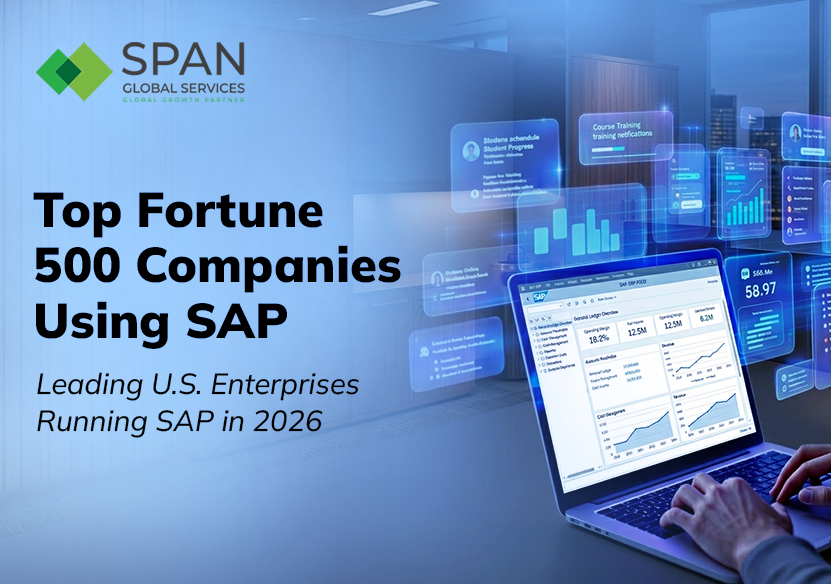
SAP is the world’s most widely adopted enterprise resource planning (ERP) software, used by more than 87 percent of Fortune 500 companies and 99 of the world’s top 100 enterprises. Founded in 1972 in Germany, SAP today serves over 425,000 customers across 180 countries and is in the middle of its biggest platform transition ever, with companies using SAP moving from SAP ECC to SAP S/4HANA and activating Joule AI through the new SAP Business AI Platform launched at Sapphire 2026.
Get the verified SAP users list →
✔ Real-time, in-memory processing through SAP HANA
✔ Industry-specific best practices across 25+ verticals
✔ Embedded Joule AI agents across finance, supply chain, procurement, and HR
✔ Global compliance and regulatory coverage
✔ Hybrid and multi-cloud deployment via RISE with SAP and GROW with SAP
✔ Open ecosystem with 24,000+ partners
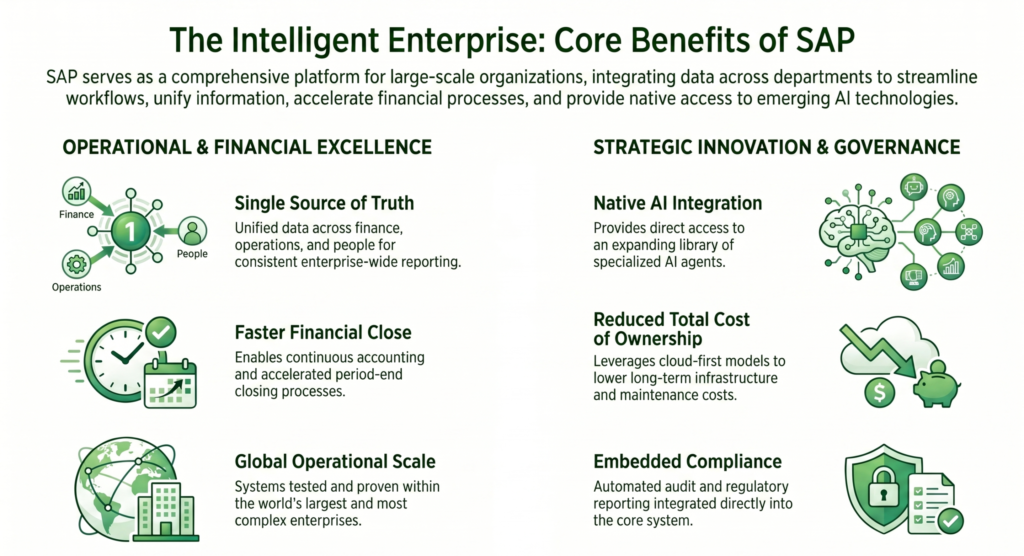
✔ Proven scale for the world’s most complex global enterprises
✔ Deep industry expertise across manufacturing, retail, energy, healthcare and financial services
✔ Strongest compliance and regulatory coverage in the ERP category
✔ Largest partner and skills ecosystem in enterprise software
✔ Embedded AI through Joule and the new SAP Business AI Platform
✔ Clear migration runway from ECC to S/4HANA backed by RISE with SAP
Get 118,000+ verified SAP user contacts mapped by product, migration stage, and decision-maker role across the Fortune 500 and beyond.
Fortune 500 Ranking: #1 | Revenue: $648.1 billion | Industry: Retail | Headquarters: Bentonville, Arkansas | Employees: 2.1 million+
Walmart has run SAP HANA in its back office since 2007, using the in-memory database to process the transactional record volume generated across its global store network. The SAP estate covers finance, supply chain coordination and inventory visibility across one of the most complex multi-tier supply chains on earth.
The retailer treats SAP as the system of record for back-office operations while running proprietary retail AI for store-level decisions. Next phase: selective S/4HANA modernization and tighter integration between SAP financial data and the broader Walmart commerce platform.
Fortune 500 Ranking: #2 | Revenue: $574.8 billion | Industry: E-commerce and Cloud Services | Headquarters: Seattle, Washington | Employees: 1.5 million+
Amazon uses SAP Integrated Business Planning for finance, supply chain planning and enterprise operations across one of the most distributed logistics networks ever built. The company is also SAP’s host of choice for thousands of customers running SAP on AWS, including SAP’s RISE with SAP private cloud workloads.
This dual position as customer and infrastructure partner gives Amazon unique vantage into how Fortune 500 SAP estates operate at scale. Next phase: deeper integration between SAP planning data and Amazon’s own AI-driven supply chain tooling.
Fortune 500 Ranking: #3 | Revenue: $383.3 billion | Industry: Technology Hardware | Headquarters: Cupertino, California | Employees: 161,000+
Apple is one of SAP’s largest single-customer accounts, running SAP across global finance, supply chain and HR. The estate underpins the most complex consumer hardware supply chain in the world, coordinating thousands of suppliers and contract manufacturers across continents.
Apple has been notably methodical about its S/4HANA modernization, prioritizing supply chain integrity over migration speed. Next phase: advanced supplier risk, sustainability and carbon accounting, and selective S/4HANA migration aligned with internal change-management capacity.
Fortune 500 Ranking: #13 | Revenue: $245.1 billion | Industry: Software | Headquarters: Redmond, Washington | Employees: 228,000+
Microsoft runs SAP S/4HANA in production for its global finance and operations, having completed one of the most publicly referenced flagship S/4HANA implementations in enterprise software. The company also hosts SAP S/4HANA Cloud Private Edition on Azure for thousands of joint customers.
Microsoft is one of the few Fortune 500 enterprises that has both completed S/4HANA migration and operates as a strategic AI partner to SAP. Next phase: agentic AI for finance close acceleration and procurement automation, with early reference adoption of the SAP Autonomous Enterprise unveiled at Sapphire 2026.
Fortune 500 Ranking: #9 | Revenue: $309.0 billion | Industry: Pharmaceutical Distribution | Headquarters: Irving, Texas | Employees: 51,000+
McKesson runs SAP across finance, supply chain and pharmaceutical distribution workflows. Regulatory complexity around serialization, traceability and cold chain has driven McKesson into one of the more advanced S/4HANA programs in healthcare distribution.
The company is actively exploring AI agent pilots in supply chain operations and demand forecasting. Next phase: AI-assisted forecasting, cold chain visibility, and continued S/4HANA migration capacity.
Fortune 500 Ranking: #11 | Revenue: $237.7 billion | Industry: Retail | Headquarters: Issaquah, Washington | Employees: 316,000+
Costco runs SAP across finance, supply chain and merchandising, supporting one of the most operationally efficient warehouse club operations in the world. The retailer’s SAP posture rewards stability and predictability over modernization velocity.
This positions Costco as a conservative S/4HANA adopter, with migration planning focused on minimizing operational risk. Next phase: selective S/4HANA modules in supply chain analytics and finance, with Joule activation still in early evaluation.
Fortune 500 Ranking: #12 | Revenue: $239.4 billion | Industry: Financial Services | Headquarters: New York City, New York | Employees: 309,000+
JPMorgan Chase uses SAP Concur for expense management, SAP SuccessFactors for HR, and SAP Ariba for one of the largest enterprise procurement programs in financial services. Core banking runs on bespoke systems while SAP anchors the back office.
The bank is among the more cautious AI adopters in the SAP layer specifically, since compliance requirements add complexity to any AI activation that touches enterprise data. Next phase: procurement intelligence, SuccessFactors expansion, and identity governance around AI agent access.
Span Global Services has verified contact data on decision-makers at every Fortune 500 SAP customer. Request a free sample to see what your campaign list could look like.
Fortune 500 Ranking: #14 | Revenue: $205.0 billion | Industry: Pharmaceutical Distribution | Headquarters: Dublin, Ohio | Employees: 48,000+
Cardinal Health runs SAP across pharmaceutical distribution, medical product supply chains and finance, engineered for the high-volume, high-regulation profile of healthcare distribution. S/4HANA evaluation and migration planning are underway across major business units.
The company is exploring early AI agent pilots in inventory management and demand forecasting. Next phase: track-and-trace integration, S/4HANA Finance migration, and AI-assisted demand planning.
Fortune 500 Ranking: #15 | Revenue: $200.9 billion | Industry: Energy | Headquarters: San Ramon, California | Employees: 45,600+
Chevron uses SAP across finance, supply chain and asset management for integrated oil and gas operations from upstream exploration through downstream refining. The company has been an active S/4HANA Cloud Private Edition adopter through RISE with SAP.
SAP-native AI activation through Joule remains in selective evaluation, with broader AI investments weighted toward operational technology. Next phase: sustainability accounting, integrated planning across upstream and downstream, and continued S/4HANA modernization.
Fortune 500 Ranking: #88 | Revenue: $45.8 billion | Industry: Beverages | Headquarters: Atlanta, Georgia | Employees: 79,000+
Coca-Cola has been an active SAP S/4HANA adopter, with migrations completed across major U.S. operations to support real-time analytics and process automation. The estate underpins finance, supply chain and manufacturing across a bottler network spanning more than 200 countries.
The company is in early stages of AI agent activation, with Joule being evaluated against finance, procurement and supply chain use cases. Next phase: beverage-specific supply chain modules, AI-assisted demand sensing, and continued S/4HANA expansion globally.
Fortune 500 Ranking: #40 | Revenue: $85.2 billion | Industry: Pharmaceuticals and Healthcare | Headquarters: New Brunswick, New Jersey | Employees: 138,100+
J&J runs one of the larger pharmaceutical SAP estates in the Fortune 500, with the platform anchoring finance, supply chain, HR and procurement across pharmaceutical and medtech units. Significant elements of the estate have already migrated to S/4HANA.
Compliance gating slows aggressive Joule deployment but allows measured agent pilots in non-regulated functions like procurement and HR. Next phase: regulatory compliance modules, AI guardrails for life sciences workflows, and continued S/4HANA migration capacity across its healthcare and pharmaceutical operations.
Fortune 500 Ranking: #41 | Revenue: $82.0 billion | Industry: Consumer Goods | Headquarters: Cincinnati, Ohio | Employees: 108,000+
P&G runs SAP across finance, supply chain, manufacturing and procurement, supporting the global operations behind consumer goods brands distributed in more than 180 countries. SAP Integrated Business Planning supports demand sensing and inventory optimization across the global manufacturing network.
P&G is among the more advanced CPG adopters of integrated AI use cases on SAP, with active pilots in agentic procurement and AI-assisted forecasting. Next phase: sustainability reporting, supply chain resilience, and expanded AI agent activation across procurement.
Fortune 500 Ranking: #21 | Revenue: $176.2 billion | Industry: Automotive | Headquarters: Dearborn, Michigan | Employees: 173,000+
Ford uses SAP across manufacturing, finance and supply chain for one of the largest automakers in the world. The estate must support an evolving manufacturing footprint that spans internal combustion, hybrid and electric vehicles, each with its own supply chain complexity.
Migration toward S/4HANA Cloud Private Edition supports broader digital transformation goals tied to electrification and connected mobility. Next phase: integrated business planning, supplier risk modules, and continued S/4HANA Cloud expansion.
Global Revenue: CHF 93.0 billion | Industry: Consumer Goods and Food | Headquarters: Vevey, Switzerland (Nestlé USA in Arlington, Virginia) | Employees: 277,000+ globally
Nestlé has implemented what SAP publicly describes as the world’s largest SAP S/4HANA Cloud Private Edition deployment to date, migrating 50,000 users across 112 countries in its Asia, Oceania and Africa operations in the first phase of a multi-year program.
Critically, Joule is integrated into core finance and operational workflows, automating journal uploads, service initiations and trade classifications. Next phase: expanding Joule across additional functions, designing agents for procurement and manufacturing, and replicating the rollout pattern across other global regions.
Market Position :
SAP serves over 425,000 customers across 180 countries. Roughly 87 percent of Fortune 500 companies and 99 of the world’s top 100 enterprises run SAP.
The 2027 ECC Deadline :
Mainstream maintenance for SAP ECC ends December 31, 2027, with extended support through 2030 at a cost premium. Compatibility Packs for S/4HANA on-premise expired end of May 2026. Only about a third of ECC customers have purchased S/4HANA licenses.
The 2027 deadline is real
Reach Fortune 500 SAP customers actively planning their S/4HANA migration. Talk to our data team about segmenting your campaign by migration stage, deployment type, and committee role.
Sapphire 2026 and the Autonomous Enterprise :
SAP unveiled the Autonomous Enterprise vision in May with 50+ Joule Assistants and 200+ specialized agents across finance, supply chain, procurement, HR and customer engagement. Anthropic Claude is now an embedded reasoning layer inside Joule.
Partner Ecosystem Investment:
SAP launched a €100 million partner fund to accelerate deployment of SAP-built and partner-built AI agents.
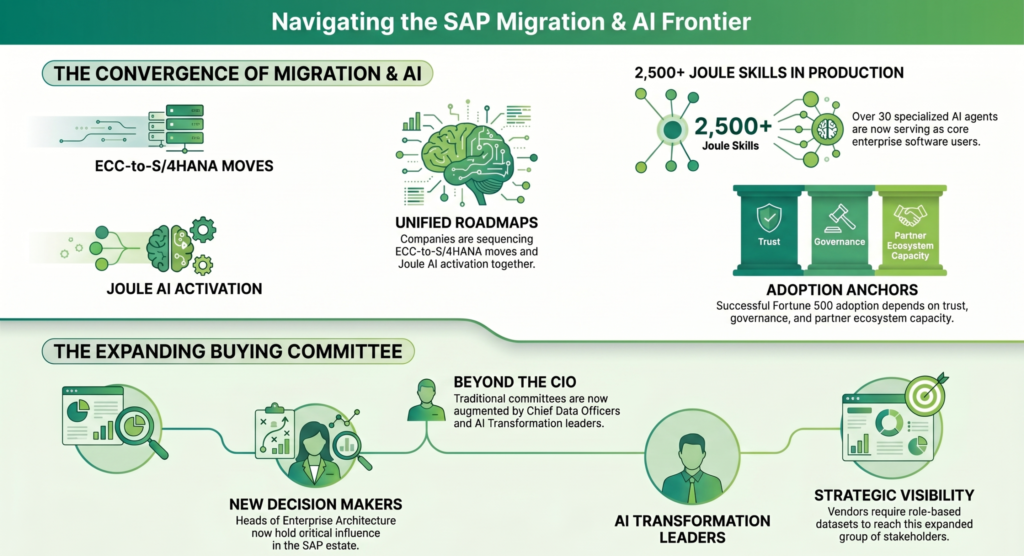
The adoption of SAP across the Fortune 500 in 2026 is no longer a question of who is on the platform. The real question is where each enterprise sits on the curve from ECC to S/4HANA, and how far along they are in activating Joule and the SAP Business AI Platform. This list, from Walmart’s HANA-backed back office to Nestlé’s record-scale S/4HANA Cloud deployment with Joule embedded, shows that the next phase of enterprise spend is anchored in modernization, AI activation and ecosystem partnerships. For technology vendors, system integrators, ISVs and B2B marketers selling into this estate, a verified, intelligence-rich SAP users list is foundational to landing in the right inbox at the right point in the migration curve. Explore the full range of technology users data to build campaigns across the enterprise stack.
Get the Span Global Services SAP users database with 118,000+ verified contacts, segmented by SAP product, migration stage, and buying committee role. Or talk to our team about a custom list for your campaign.