Your campaign just hit 5,000 inboxes labeled “MSPs.” One of them belongs to a SOC director who has never signed a help desk contract in her life. She deleted it in under two seconds, and your reply rate took the hit without anyone knowing why.
MSP and MSSP look like a one-letter difference. In your pipeline, that one letter can be the difference between a booked meeting and a hard bounce. A managed service provider (MSP) keeps a company’s technology running. A managed security service provider (MSSP) keeps it from being breached. Same suffix, different businesses, different buyers, different budgets.
Most articles stop at that definition. This guide goes further. If you sell to, market to, or partner with these providers, the distinction affects who you target, who signs the contract, and what message actually gets a response. MSPs and MSSPs may operate in similar markets, but they have different priorities, buying triggers, and decision-makers. Treating them as the same audience is one of the easiest ways to waste outreach, budget, and pipeline opportunities.
A managed service provider runs a company’s IT environment for a predictable monthly fee. Think help desk, device monitoring, patching, cloud administration, networks, backup, and IT strategy. The MSP is the outsourced or co-managed IT department, measured on uptime, response times, and keeping the lights on.
Security is usually part of the package, but as one layer among many: antivirus, firewalls, multi-factor authentication, maybe email filtering. The MSP’s center of gravity is operations, not threat defense.
A managed security service provider does one thing and goes deep: cybersecurity. That means 24/7 threat monitoring through a security operations center (SOC), managed detection and response (MDR), SIEM, vulnerability management, incident response, and compliance reporting against frameworks like HIPAA, PCI DSS, and CMMC.
An MSSP is not trying to fix the marketing director’s broken laptop. It is watching for the intrusion at 2 a.m. that the marketing director will never see. The global managed security services market reached roughly 39 billion dollars in 2025 and is projected to hit about 67 billion by 2030, growing around 11 percent a year, according to “MarketsandMarkets”. That growth is pulling more providers into security every quarter, which is exactly where the confusion starts.
Here is the side-by-side that matters when you are deciding which one you are dealing with, or which one you are selling to.
| Dimension | MSP | MSSP |
|---|---|---|
| Core focus | IT operations and uptime | Cybersecurity and threat defense |
| Typical services | Help desk, RMM, cloud, networks, backup | SOC, MDR, SIEM, incident response, compliance |
| Coverage | Business hours, often with after-hours support | 24/7/365 monitoring by design |
| Who buys it | Owner, operations lead, or vCIO | CISO, security lead, or compliance officer |
| Buying trigger | Growth, downtime, an IT hire leaving | A breach, an audit, a cyber insurance demand |
| Success metric | Uptime and ticket resolution | Threats detected and contained |
| Compliance role | Supports it | Owns and certifies it |
The two rows that get ignored most are who buys it and buying trigger. An MSP sale often starts with frustration about things breaking. An MSSP sale often starts with fear: a breach in the news, a failed audit, an insurer refusing to renew without a SOC in place. Different emotion, different buyer, different message. We will come back to this.
Here is the part the commodity articles miss. The neat MSP-versus-MSSP split is dissolving in real time, and the data shows it.
In 2025, security-specialist MSSPs held only about 32% of managed security services revenue, according to Mordor Intelligence. Read that again: roughly two-thirds of all managed security spend now flows to providers that are not pure-play MSSPs. IT integrators, cloud hyperscalers, and traditional MSPs that bolted on a security practice are absorbing the majority of the market.
This is the MSSP drift.
MSPs are adding SOC services because clients demand security and cyber insurers require it. MSSPs are broadening into managed IT because clients want one throat to choke. The label on the website no longer tells you what the company actually sells.
For a buyer, that blur is mildly annoying. For anyone trying to market to these providers, it is a data problem with a price tag. You cannot segment a market by what companies call themselves when half of them call themselves the wrong thing. You have to segment by what they actually do.
If you sell software, hardware, or services into this channel, treating “MSPs and MSSPs” as one audience is the mistake. Here is the four-step framework we recommend for splitting them, so your campaigns speak to the right buyer with the right trigger.
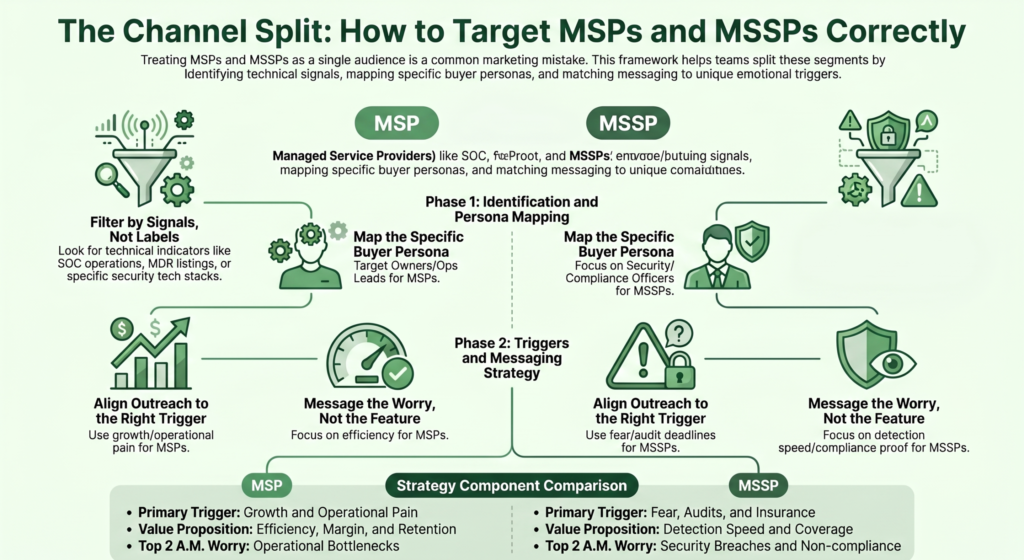
Stop filtering on the company name or a self-reported category. Filter on signals: does this provider run a SOC, hold SOC 2 or ISO 27001, list MDR or SIEM on its site, or carry security-specific tech in its stack? Those signals tell you whether you are looking at an MSP, an MSSP, or a hybrid, regardless of the logo.
The person who buys your offering at an MSP is rarely the person who buys it at an MSSP. At an MSP, it is often the owner, the operations lead, or a virtual CIO. At an MSSP, it is a security leader or compliance officer. One list, two buyer personas. If your contacts are not tagged by role, you are guessing.
MSP buyers move on growth and operational pain. MSSP buyers move on fear and obligation: a breach, an audit deadline, a cyber insurance clause. Time your outreach and your subject lines to the trigger that fits the segment, not a generic ‘improve your IT’ message that lands flat with both.
To the MSP, lead with efficiency, margin, and client retention. To the MSSP, lead with detection speed, coverage, and compliance proof. Same product, two stories. The version that wins is the one that names the buyer’s actual 2 a.m. worry.
If you landed here as a buyer rather than a marketer, the short version: if your pain is downtime, slow support, and an IT environment nobody owns, you need an MSP.
If your pain is risk, compliance, and the very real possibility of a breach you would not detect for months, you need an MSSP. Many mid-sized companies end up needing both, which is why hybrid providers are winning.
For a fuller breakdown of provider types and how to choose, see our guide to managed service providers in the USA.
The Channel Split framework only works if your data already knows the difference between an MSP and an MSSP. That is not a given. Most prospect lists treat the channel as one undifferentiated blob, which is precisely why campaigns to “MSPs” keep landing in the wrong inboxes.
Span Global Services builds the layer that makes this segmentation possible: verified, compliant contact data for the technology channel, segmented by service line, certification, tech stack, and decision-maker role. That means a managed service provider email list you can split into operations buyers and security buyers, broader technology user lists for the hybrids, and decision-maker data like a CIO and CISO contact list for the people who actually sign. You can request a free sample to check the segmentation before you commit.
Run the Channel Split on data that already carries the signals, and the one-letter difference between MSP and MSSP stops costing you meetings.
An MSP manages a company’s overall IT operations for a monthly fee. An MSSP focuses only on cybersecurity, including 24/7 monitoring, threat detection, and incident response. MSPs keep technology running; MSSPs keep it secure.
Yes, and increasingly they are. Many MSPs have added security operations, and many MSSPs have broadened into managed IT. In 2025, non-specialist providers captured most managed security revenue, which is why the labels alone no longer tell you what a company sells.
If your problem is downtime, support, and day-to-day IT, you need an MSP. If your problem is cyber risk, compliance, or a possible breach, you need an MSSP. Companies with both operational and security gaps often use a hybrid provider or both.
Because they have different buyers, budgets, and buying triggers, an MSP buyer is usually an owner or operations lead motivated by growth. An MSSP buyer is usually a security or compliance leader motivated by risk. Targeting them with one message wastes budget on both.
Often, yes, because security operations require a SOC, specialized tooling, and around-the-clock staffing. Pricing depends on scope, coverage, and compliance requirements rather than the label itself.