Platform consolidation is the defining enterprise theme. Modern IT buyers are exhausted by managing dozens of fragmented point solutions. They are aggressively migrating toward unified security fabrics that can natively feed automated workflows and agentic defense systems.
For B2B marketing and sales teams executing software displacement campaigns or launching product integrations, understanding the territory lines of global security giants is a pipeline requirement. Selling competitive or complementary software requires knowing exactly where these systems live.
This guide details the global market share landscape of top cybersecurity companies, categorized by deployment type, structural advantage, and how to utilize this insight to fuel enterprise outbound campaigns.
The enterprise security ecosystem is dominated by a few multi-billion dollar ecosystems. The following layout details how market share is split across core digital defense segments.
| Security Segment | Global Market Leaders | Primary Structural Transition |
|---|---|---|
| Cloud Security (CNAPP) | Wiz, Palo Alto Networks | Transitioning from static configuration audits to automated identity governance and agentless real-time threat response. |
| Endpoint Protection & XDR | CrowdStrike, SentinelOne | Shifting away from heavy local machine scanning toward cloud-native telemetry engines running machine-speed remediation. |
| Zero Trust / SASE | Zscaler, Cloudflare | Moving from traditional office hardware appliances to globally distributed edge routing networks that protect remote workforces. |
The race to secure cloud infrastructure is one of the most capital-intensive areas of corporate technology spending.
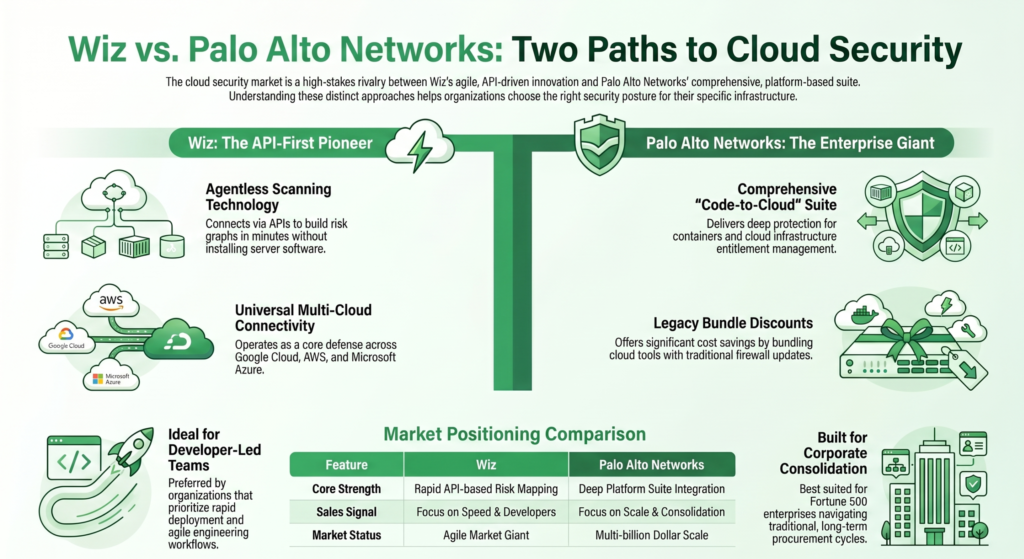
Wiz established itself as a market giant by pioneering agentless scanning. Instead of requiring engineering teams to install software on every single cloud server, Wiz connects via application programming interfaces (APIs) to build a complete visual graph of risk configurations in minutes. Following its integration into Google Cloud, Wiz operates as a core element of hyperscaler defense architectures while maintaining its multi-cloud connectivity across Amazon Web Services (AWS) and Microsoft Azure.
Palo Alto Networks commands a massive portion of enterprise cloud security revenue through its Prisma Cloud platform. Unlike younger competitors, Palo Alto delivers an incredibly deep suite that covers code-to-cloud security, container protection, and cloud infrastructure entitlement management. Their multi-billion dollar scale allows them to bundle cloud posture tools with legacy firewall updates, offering deep cost discounts to Fortune 500 enterprises looking to consolidate their security vendors.
Data Intelligence for Tech Sales Teams: Knowing whether a target company utilizes agentless API security or a broad legacy platform dictates your marketing angle. If you sell developer-focused tools, targeting a Wiz-installed base guarantees an audience that values rapid deployment. If you sell long-term enterprise software, a Palo Alto Users List signals a traditional corporate procurement cycle.
Securing individual laptops, workstations, and server nodes remains a fundamental piece of corporate IT budgets. The market share in this arena is a fierce two-way race.
| Security Provider | Market Statistics & Strategic Playbook |
|---|---|
| CrowdStrike Falcon | Market Status: Premium Industry Leader (Annual Run-Rate: $5.25B+)
Core Strategy: Unified platform telemetry and centralized data layer |
| SentinelOne Singularity | Market Status: High-Growth Industry Challenger (Revenue: $1B+)
Core Strategy: Fully automated threat processing running directly on the local endpoint device |
CrowdStrike stands as a premium leader in the endpoint domain. The Falcon platform processes trillions of events daily using a single, lightweight software agent. Despite historical industry outages, its platform stickiness remains exceptionally high, with enterprise accounts showing near-zero churn metrics. CrowdStrike leverages its massive telemetry engine to expand into adjacent fields like identity defense and log management, turning its endpoint footprint into a comprehensive corporate directory.
SentinelOne is a high-growth challenger that crossed the landmark one billion dollar revenue threshold. The primary differentiator for SentinelOne is its focus on local machine learning. While other platforms require continuous cloud connectivity to process threat telemetry, SentinelOne runs automated identification directly on the device. This makes it an attractive deployment option for critical infrastructure, government networks, and highly regulated spaces where network disconnections can happen.
As data centers empty out into cloud environments, traditional hardware firewalls are being swapped for Secure Access Service Edge (SASE) platforms.
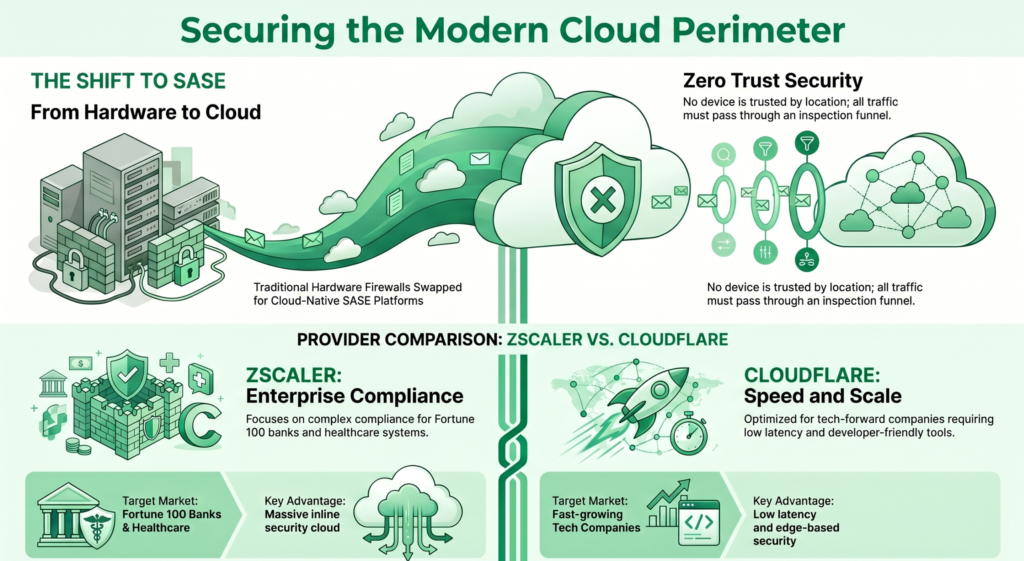
Zscaler controls a massive share of the enterprise web proxy and secure access market. Operating the world’s largest inline security cloud, Zscaler forces all employee traffic through an inspection funnel before allowing access to external sites or internal apps. It acts as an invisible security guard for corporate networks, ensuring that no device is trusted simply because of its physical location.
Cloudflare attacks the SASE market from a different vantage point. Leveraging its enormous global content delivery network, Cloudflare built out its Cloudflare One suite to provide fast, edge-based security. While Zscaler targets the complex compliance needs of Fortune 100 banks and healthcare systems, Cloudflare dominates fast-growing tech companies and organizations looking for rapid setup, low network latency, and developer-friendly controls.
Compiling a list of these market leaders is the starting point. To build an effective go-to-market strategy, your sales and marketing alignment must translate these technographic footprints into segmented messaging.
Related Reading: Learn how data intelligence transforms your launch with Predictive Analytics in Modern Go-to-Market Strategies.
If your software replaces or optimizes an asset within these ecosystems, your outreach needs to target specific pain points:
In modern sales workflows, automated systems and AI-driven prospecting pipelines are only as good as the data fed into them. Technographic data decays rapidly as corporations switch software platforms or replace security leadership tiers.
| Data Sourcing Type | Operational Mechanics & Direct Pipeline Impact |
|---|---|
| Traditional AI Scrapers | Process: Automated web scraping without verification layers
Pipeline Result: High data decay rates, outdated titles, bounced emails, and domain health risks |
| Span Global Services | Process: Real-time AI mapping combined with live human tele-verification
Pipeline Result: Verified technological footprints, clean inbox delivery, and maximum outbound ROI |
Relying on raw data scraping often leads to high email bounce rates, damaged domain reputations, and misdirected sales pitches. To land meeting bookings with high-level technology decision makers, enterprise lists must be backed by layered verification.
Span Global Services bridges this gap by combining automated tracking systems with human tele-verification. This ensures you do not waste resources sending messages to invalid domains or targeting executives who left their positions months ago.
Our Cybersecurity Software Users List gives you direct access to over fourteen thousand verified global companies mapped by their real-time technology environments.
Stop burning pipeline spend on unverified datasets and outdated technical footprints. Get immediate access to high-intent technology buyers actively managing enterprise security environments.
Get Clean Leads Now: Click to Download Your Free Cybersecurity Data Sample
Palo Alto Networks maintains the largest aggregate revenue market share in enterprise security, driven by its multi-product platform approach spanning corporate networks, cloud environments, and automated security operations centers.
Agentless security connects directly to infrastructure through cloud APIs to map vulnerabilities without installing software. Agent-based platforms require a lightweight program installed directly on the physical host machine to provide deep, real-time remediation capabilities.
Managing multiple specialized tools introduces visibility gaps, causes procurement bloat, and strains security engineering teams. Platforms that unify network, cloud, and endpoint telemetry under a single pane of glass lower administrative costs and catch complex threats faster.
Technographic tracking reveals the exact applications a target account uses. This allows sales groups to completely skip the discovery phase, craft highly specific integration pitches, and achieve significantly higher conversion rates compared to generic outbound messaging.
Enterprise infrastructure updates or vendor replacements occur on average every two to three years. However, internal contact information and department leadership roles fluctuate continuously, making data decay an ongoing challenge for outbound lists.