It’s the boardroom question nobody wants to answer directly and the ambiguity is costing companies more than they realize.
A Fortune 500 company recently approved a $40M AI transformation budget. Six months later, three different executives were still arguing about which department’s P&L it should sit on. The CIO said AI was infrastructure. The CTO said it was product. The newly minted CAIO said it was neither, it was a capability, and it belonged to everyone. They were all right. Which is why nothing moved?
This isn’t a story about dysfunction. It’s a story about how AI has broken the org chart in a way that nobody designed for and how most enterprises are now navigating a power vacuum dressed up as a strategy discussion.
“AI budget wars aren’t really about money. They’re about who gets to define what AI is inside the company.”
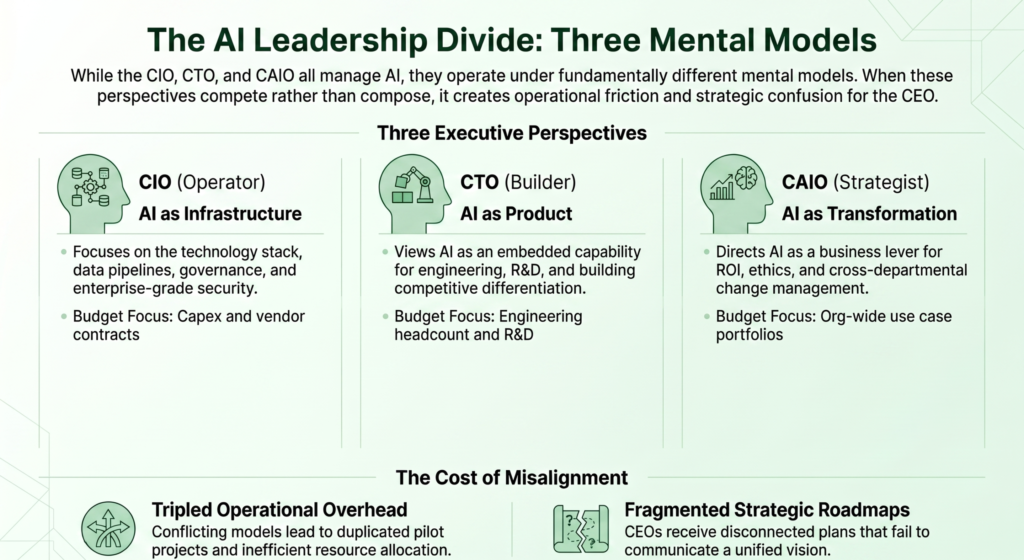
To understand the conflict, you first have to understand that the CIO, CTO, and CAIO aren’t just fighting over budget lines. They’re operating from fundamentally different definitions of what AI actually is and each definition is internally consistent.
The Operator sees AI as infrastructure: compute, data pipelines, governance, procurement. AI is another layer of the technology stack that must be standardized, secured, and made enterprise-grade. Budget = capex + vendor contracts.
The Builder sees AI as a product capability; something that gets embedded into what the company ships or how it’s built. Budget = engineering headcount, R&D, and build-vs-buy decisions for competitive differentiation.
The Strategist sees AI as a business transformation lever cutting across departments, ROI models, change management, and ethics. Budget = org-wide use case portfolio with accountability to the CEO or board, not IT or Engineering.
None of these views is wrong. The problem is that in most organizations, these mental models compete instead of composing. The result? Tripled overhead, duplicated pilots, and a CEO who gets three different AI roadmaps that don’t talk to each other.
Corporate budgets were built around departments with clear ownership. Marketing owns the CRM. Engineering owns the codebase. IT owns the network. AI refuses this model because a single AI initiative can simultaneously be infrastructure (a GPU cluster), a product feature (a recommendation engine), and a business transformation program (replacing a call centre workflow). It belongs everywhere and therefore, nowhere.
This is genuinely new territory. Cloud computing caused a similar organizational crisis in the early 2010s, but it was ultimately resolved because cloud was still recognizable as “IT infrastructure, just rented.” AI is harder: it can be a tool, a worker, a decision-maker, and a competitive moat sometimes in the same week.
The CAIO as a Strategic Compromise: In many organizations, the Chief AI Officer role is introduced to break operational deadlocks between the CIO and CTO, allowing the executive team to demonstrate a commitment to AI transformation without undergoing a disruptive structural reorganization. However, without clearly defined ownership, the role risks carrying immense accountability without the corresponding authority.
The Value of Portfolio Control: The most successful CAIOs function similarly to internal venture capitalists. Rather than competing for ownership of core technology infrastructure or product roadmaps, they manage the enterprise AI investment portfolio. Their value lies in controlling budget allocation deciding which AI initiatives are funded, scaled, or phased out, and establishing unified success metrics across the company.
The Pitfalls of a Pure Advisory Role: Conversely, the role is weakest when limited to a centralized advisory hub. When a CAIO’s focus is confined to hosting educational workshops, creating theoretical frameworks, and drafting governance policies without direct financial oversight, they are frequently excluded from core business decisions. Without budget authority, a C-suite title risks becoming a symbolic communication role rather than a driver of strategic execution.
Rather than a single owner, the mature answer is a split ownership model, but one that’s deliberate, not accidental.
| AI Budget Layer | Who Should Own It | Why |
|---|---|---|
| Compute & Data Infrastructure | CIO | Governance, procurement, enterprise architecture – classic IT territory |
| AI in Product / Engineering | CTO | Embedded AI is a build decision, tied to engineering velocity and roadmap |
| Cross-functional Use Cases | CAIO | No single department owns this; someone neutral must hold the portfolio |
| AI Risk & Compliance | CIO + CAIO (joint) | Straddles infrastructure policy and enterprise-wide accountability |
| AI Talent & Upskilling | CAIO + CHRO | Change management is a people problem, not a technology problem |
The key word is deliberate. The same split that works poorly when it happens by accident works well when the CEO explicitly draws the lines and gives each leader a mandate they can defend.
Here’s the variable that most governance discussions skip: it’s not just who holds the AI budget, it’s who they report to. A CTO who reports to the CEO will protect AI budget differently than one who reports to the COO. A CAIO who reports to the CIO will prioritize infrastructure decisions. A CAIO who reports directly to the CEO is being handed a mandate to disrupt the existing technology hierarchy.
Reporting line = actual power. And in most organizations, the CAIO reporting line reveals whether the role is genuinely strategic or ceremonially symbolic. If the CAIO sits three levels below the CEO inside an IT org, budget authority will be limited regardless of title.
Every AI budget fight is ultimately a symptom of the CEO not having taken a position on what AI is for the company. Is it a cost reduction engine? A product differentiator? A competitive survival requirement? The answer to that question determines who should own the budget and yet most CEOs are still treating AI as “all of the above,” which is the organizational equivalent of no answer at all.
The companies that have resolved this cleanest are the ones where the CEO made a call. Not a committee. Not a task force. One call: “We are using AI primarily to compress operational costs in the next 18 months the CIO leads with CAIO support.” Or: “We are using AI to build new product lines, CTO leads with a dedicated budget ring-fenced from infrastructure.” The specificity is the point. Ambiguity is what feeds turf wars.
There’s also a timing dimension that gets ignored. AI budget ownership structures that made sense in 2022 (mostly CIO, mostly infrastructure) are wrong for 2026, where AI is embedded in products, workflows, and hiring decisions simultaneously. The org needs to update the ownership model as the nature of AI spend shifts and that requires a CEO who revisits the question annually, not once.
Shared ownership models sound mature and collaborative in strategy decks. In practice, they tend to produce consensus paralysis every decision requires three sign-offs, and accountability is diluted to the point where nobody feels truly responsible for outcomes.
The practical advice: for now, pick a primary owner. Give them the budget, the mandate, and the accountability. Formalize the support roles of the other executives. Review and revise in 12–18 months as the AI landscape inside your company changes.
If your company is primarily an operations and efficiency story, the CIO is your best primary owner. If AI is fundamentally reshaping your product, the CTO should lead. If AI spans the entire value chain and is core to the company’s strategic identity, build the CAIO role with real P&L authority or you’ve just hired an expensive storyteller.
Building an outreach program around AI decision-makers? Span Global Services provides verified, segmented contact data for the full C-suite, from CIOs and CTOs to Chief AI Officers.