

Total Addressable Market (TAM) calculations that worked in 2023 are obsolete in 2026’s AI-transformed business landscape. Artificial intelligence has fundamentally reshaped B2B buying behaviors, compressed sales cycles, eliminated traditional market boundaries, and created entirely new customer segments while rendering others irrelevant. Companies relying on pre-AI TAM models risk catastrophic strategic errors overestimating markets that AI has commoditized, underestimating opportunities AI has created, and missing transformative revenue streams entirely.
This comprehensive guide provides frameworks for recalculating your TAM in 2026’s AI-driven reality, accounting for machine learning automation, generative AI adoption, autonomous systems, and the dramatic market shifts these technologies have triggered across every B2B sector.

Total Addressable Market represents the total revenue opportunity available if your product or service achieved 100% market share. Traditional TAM calculations used three primary methodologies:
Top-Down Approach: Starting with broad market research reports and narrowing to your specific segment
Bottom-Up Approach: Calculating based on pricing and the number of potential customers
Value Theory Approach: Estimating based on the value your solution provides to customers
These methodologies assumed relatively stable market conditions, predictable buyer behaviors, and clear competitive boundaries. AI has invalidated all three assumptions.

Artificial intelligence has disrupted traditional TAM calculations in five fundamental ways that require completely rethinking market sizing approaches:
Market Expansion Through Automation: AI has made previously manual, expensive solutions accessible to mid-market and SMB segments that couldn’t afford human-delivered services. Legal research platforms powered by AI can serve 50,000 small law firms instead of 500 large ones. Financial analysis tools can reach 100,000 SMB CFOs instead of 1,000 enterprise finance departments. Your addressable market may have grown 10-100x while you weren’t looking.
Market Compression Through Commoditization: Conversely, AI has commoditized solutions that commanded premium pricing in 2023. Content creation, customer service, basic analysis, and routine professional services now face AI alternatives at fraction of traditional costs. If your solution competes with AI capabilities, your TAM may have shrunk dramatically or shifted entirely to integration and customization services rather than core functionality.
New Buyer Personas Emerging: AI has created entirely new decision-maker roles that didn’t exist two years ago Chief AI Officers, AI Ethics Compliance Directors, Machine Learning Operations Managers, and Prompt Engineering Teams. These new personas have budgets, purchasing authority, and needs that traditional TAM models never accounted for.
Dissolved Geographic Boundaries: AI-powered translation, communication, and localization have eliminated geographic constraints that previously limited TAM. A SaaS platform that realistically served only English-speaking North American markets in 2023 can now authentically serve 50+ languages across global markets with AI translation and cultural adaptation. Your geographic TAM multiplier may have increased 5-10x.
Accelerated Market Maturity: AI has compressed adoption curves from years to months. Technologies that would have taken 5-7 years to reach mainstream adoption are achieving it in 12-18 months due to AI-powered onboarding, training, and support. This acceleration means previously “future TAM” is actually “current TAM” requiring immediate strategic response.
Before recalculating, conduct a comprehensive audit of existing TAM assumptions to identify which remain valid and which AI has invalidated.

Examine each customer segment in your current TAM model through an AI lens:
Segment Expansion Analysis: Which customer types can now afford or access your solution due to AI-driven cost reduction? If AI automation reduced your delivery cost by 70%, which previously unprofitable customer segments become viable? If AI-powered self-service eliminates onboarding friction, which segments previously requiring extensive hand-holding become self-sufficient?
Segment Erosion Analysis: Which customer types can now solve their problems with AI alternatives instead of your solution? Are you selling content creation services when ChatGPT handles 80% of use cases? Are you providing basic analysis that AI tools now deliver instantly? Identify segments where AI substitution threatens your value proposition.
Segment Transformation Analysis: Which customer needs have fundamentally changed due to AI adoption? Companies that needed data analysts now need AI model trainers. Organizations requiring customer service representatives now need AI conversation designers. Your customer segments may still exist but need entirely different solutions than your current offering.
Reassess geographic TAM assumptions based on AI-enabled global reach:
Language Barrier Elimination: AI translation now enables authentic engagement with markets previously inaccessible due to language constraints. Calculate realistic expansion into non-English markets considering AI-powered localization, customer support, and content adaptation. Your effective geographic TAM may have quintupled.
Regulatory Adaptation: AI compliance tools make navigating complex regional regulations feasible for mid-sized companies. Markets like the EU, which previously required extensive legal resources to enter, become accessible with AI-powered regulatory compliance monitoring and automated documentation.
Remote Delivery Enhancement: AI has perfected remote service delivery, eliminating “must be local” assumptions. Professional services, technical support, and consultative selling that required local presence can now scale globally with AI-augmented remote teams.
Analyze how AI has reshaped your competitive environment:
New AI-Native Competitors: Identify startups and tech giants offering AI-powered alternatives to your solution at radically different price points. These competitors may be targeting different initial segments but will expand into your core market rapidly.
Traditional Competitors with AI Enhancements: Assess how existing competitors have integrated AI to expand their own TAM. If competitors added AI features enabling them to serve segments you can’t reach, your effective TAM may have shrunk even if the total market grew.
Unexpected Competition from AI Platforms: General-purpose AI platforms like OpenAI, Anthropic, Google, and Microsoft increasingly offer capabilities that overlap with specialized solutions. A company needing basic data analysis might use Claude or ChatGPT rather than specialized analytics software. Factor this platform competition into TAM calculations.
AI hasn’t just modified existing markets it has created entirely new ones that represent TAM expansion opportunities if you position appropriately.

Organizations adopting AI face massive implementation challenges creating new service markets:
AI Strategy and Roadmap Development: Companies need guidance selecting from thousands of AI tools, defining use cases, and building implementation roadmaps. This consulting market didn’t exist meaningfully in 2022 but represents billions in TAM by 2026.
AI Integration and Customization: Off-the-shelf AI solutions require customization to specific business processes, data sources, and workflows. Integration services connecting AI platforms to existing systems represent massive TAM expansion for system integrators, consultants, and specialized integration platforms.
AI Model Training and Fine-Tuning: Organizations want proprietary AI models trained on their data, processes, and domain expertise. Services providing custom model development, fine-tuning, and ongoing training represent entirely new TAM categories.
AI adoption creates regulatory, ethical, and operational governance needs:
AI Ethics and Bias Monitoring: Companies deploying AI need tools and services ensuring models don’t produce biased, discriminatory, or problematic outputs. This compliance market barely existed in 2023 but is mandatory for regulated industries by 2026.
AI Audit and Transparency Solutions: Regulators and customers demand visibility into AI decision-making processes. Solutions providing AI explainability, audit trails, and transparency documentation serve a rapidly growing TAM.
AI Risk Management Platforms: Organizations need frameworks assessing and mitigating risks from AI deployment from data privacy concerns to operational dependencies on AI systems to reputational risks from AI failures.
Rather than replacing humans entirely, most AI augments human capabilities, creating new tool categories:
AI Copilots for Specialized Roles: Every professional role is getting AI assistants – developer copilots, design copilots, sales copilots, legal copilots. Each specialized copilot category represents distinct TAM based on the number of professionals in that role globally.
AI-Powered Decision Support Systems: Executives and managers need AI tools synthesizing vast information into actionable insights. Decision intelligence platforms serving this need represent significant new TAM.
AI Training and Upskilling Platforms: Organizations must train employees to work effectively with AI. Corporate training platforms focused on AI literacy, prompt engineering, and AI-augmented workflows serve a rapidly expanding TAM as every company becomes an AI company.
AI’s data requirements create infrastructure opportunities:
Data Pipeline and Preparation Services: AI models require clean, structured, labeled data. Services and platforms providing data preparation, labeling, and pipeline management serve the foundational need underlying all AI adoption.
Vector Databases and AI-Optimized Storage: AI workloads require specialized database architectures. Vector databases, embeddings storage, and AI-optimized data infrastructure represent new TAM categories growing alongside AI adoption.
Synthetic Data Generation: Training AI models requires massive datasets. Synthetic data generation services creating realistic training data without privacy concerns serve a multi-billion dollar TAM.
With audited assumptions and identified new opportunities, recalculate TAM using methodologies adapted for AI-era realities.

Start with credible market research but apply AI-specific adjustments:
Base Market Identification: Begin with analyst reports on your industry’s total market size. Sources like Gartner, Forrester, IDC, and McKinsey publish AI-adjusted market forecasts for most sectors.
AI Expansion Multiplier: Apply expansion factors for AI-enabled market growth. If AI automation makes your solution accessible to 10x more companies due to reduced price points, multiply your serviceable market by 10. If AI removes geographic constraints, multiply by the number of newly accessible regions.
AI Compression Divisor: Apply reduction factors for AI commoditization. If AI alternatives can serve 30% of your traditional use cases at lower cost, reduce your TAM by 30% for those segments while calculating new TAM for AI-adjacent services.
Formula: Adjusted TAM = (Base Market Size × AI Expansion Multipliers) – (Base Market Size × AI Compression Factors) + New AI-Created Opportunity TAM
Calculate based on updated customer counts and AI-influenced pricing:
Total Target Customers: Count all organizations that could use your solution. Apply AI-enabled expansion factors, if AI made your solution feasible for companies 1/10th the size of your traditional targets, multiply customer count by 10x or more.
Average Revenue Per Customer (ARPC): Recalculate based on AI-influenced pricing dynamics. AI might enable lower-priced tiers serving more customers at reduced ARPC, or AI might enable premium tiers with AI-powered features at higher ARPC. Model both scenarios.
Adoption Rate Assumptions: Adjust for AI-accelerated adoption curves. Technologies reaching 20% penetration in 5 years pre-AI might reach it in 18 months now. Update your realistic penetration assumptions accordingly.
Formula: AI-Adjusted TAM = (AI-Expanded Customer Count) × (AI-Influenced ARPC) × (Realistic Market Penetration Rate)
Calculate TAM based on the value AI enables you to deliver:
Value Creation Quantification: Measure the specific value your AI-powered solution creates for customers. If your AI tool saves each customer $500,000 annually in labor costs, that’s your value creation baseline.
Willingness to Pay Estimation: Customers typically pay 10-30% of the value created. If you save $500,000, you can charge $50,000-$150,000. Use industry benchmarks and customer research to estimate realistic pricing as a percentage of value delivered.
Market Size Calculation: Multiply per-customer value by the number of potential customers who would benefit from this value creation.
Formula: Value-Theory TAM = (Number of Target Customers) × (Annual Value Created) × (Typical Value Capture Rate)
Not all potential customers are equally ready for AI solutions. Segment TAM by AI adoption maturity to create realistic go-to-market strategies.

Organizations aggressively adopting AI, experimenting with cutting-edge models, and building proprietary AI capabilities. These customers:
Organizations actively implementing AI across multiple use cases with dedicated AI budgets and leadership. These customers:
Organizations beginning AI exploration, running pilot projects, and building business cases. These customers:
Organizations skeptical of AI, waiting for industry standards, and adopting only when necessary. These customers:
Organizations resisting AI adoption, maintaining legacy approaches, or facing regulatory barriers. These customers:
Strategic Implication: Your realistic 2026 TAM includes Innovators and Early Adopters (20% of total market). Your 2027-2028 TAM expands to include Early Majority (55% cumulative). Don’t claim the full 100% as addressable in 2026 it’s not.
Given AI’s rapid evolution, model multiple scenarios rather than single TAM projections.

Assumes slower AI adoption, limited market expansion, and continued competition:
Assumes moderate AI adoption aligned with current trends:
Assumes rapid AI adoption, dramatic market transformation:
Plans for discontinuous AI breakthroughs (AGI, dramatic cost reductions):
Model all four scenarios. Present Base Case as your primary TAM. Use Conservative for minimum viable planning. Reference Aggressive for upside opportunity. Prepare contingencies for Black Swan events.
Theoretical calculations require market validation before basing strategy on them.

AI Adoption Surveys: Survey your target customers about their AI plans, budgets, and priorities. What percentage are actively implementing AI? What’s their timeline? What’s their budget allocation?
Willingness-to-Pay Studies: Test pricing assumptions with real prospects. Will SMBs actually pay for AI-enabled solutions at the price points you’re modeling? Will enterprise customers pay premiums for AI features?
Competitive Win/Loss Analysis: Analyze recent deals. Are you losing to AI alternatives? Are you winning in AI-expanded segments? Actual market performance validates or refutes TAM assumptions.
Cross-Reference Multiple Sources: Don’t rely on single market reports. Compare Gartner, Forrester, IDC, CB Insights, and specialized AI research firms. Where estimates converge, confidence increases. Where they diverge, investigate why.
Industry Expert Interviews: Talk to 20-30 industry experts, analysts, VCs, and practitioners. Do they agree with your TAM expansion assumptions? What are you missing?
Competitive Funding Analysis: Track competitor fundraising and investor presentations. VCs funding your competitors have validated TAM assumptions. If competitors raise massive rounds, investors believe in large TAM. If funding dries up, TAM may be smaller than hoped.
Limited Market Entry: Before betting the company on 10x TAM expansion, test it. Launch in one AI-expanded segment. Does demand materialize at assumed price points? Do customers actually adopt?
Conversion Rate Reality Check: Your TAM assumes certain conversion rates. Test them. If you assumed 5% of SMBs would buy your AI-enabled solution at $500/month, run targeted campaigns to 1,000 SMBs and measure actual conversion. Adjust TAM based on reality.
A recalculated TAM is useless without strategic implications for product, marketing, and sales.

Build vs. Partner Decisions: If new AI-created TAM opportunities are large but outside your core competency, should you build those capabilities or partner with AI specialists? Calculate the TAM you can realistically capture with each approach.
Feature Prioritization: Which AI features unlock the most TAM expansion? Prioritize development resources toward capabilities that access the largest new market segments.
Pricing Model Evolution: Does your AI-adjusted TAM require consumption-based pricing instead of seat-based? Freemium models to access AI-expanded SMB segments? Premium tiers for AI-enhanced features?
Sales Segmentation: Organize sales teams around AI maturity stages. Your enterprise sales team pursuing AI Innovators needs different skills than your inside sales team serving AI Early Majority SMBs.
Marketing Message Evolution: Traditional value propositions may not resonate with AI-expanded segments. SMBs buying your solution for the first time due to AI-reduced pricing need different messaging than enterprise customers adding AI features to existing deployments.
Channel Strategy: AI-expanded TAM may require new distribution channels. If you’re newly serving 100,000 SMBs instead of 1,000 enterprises, you likely need channel partners, self-service onboarding, and product-led growth instead of field sales.
Investment Requirements: TAM expansion requires investment. If your addressable market grew 8x but serves smaller customers, you need scaled-down onboarding, automated support, and self-service infrastructure. Budget accordingly.
Revenue Forecasting: Don’t assume you can capture TAM proportionally. If your market grew 8x but you’re capturing 2% instead of 5%, your revenue grew 3.2x, not 8x. Model realistic market share scenarios.
Burn Rate Justification: Recalculated TAM justifies different investment levels. If TAM is genuinely 10x larger than previously thought, aggressive investment makes sense. If TAM contracted due to AI commoditization, conserve cash and pivot.
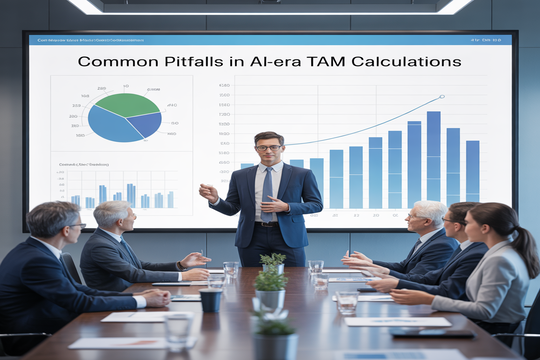
Avoid these frequent mistakes when recalculating TAM for 2026:
Overestimating AI Readiness: Just because AI could expand your TAM doesn’t mean customers are ready. Many organizations lack data infrastructure, technical expertise, or change management capacity to adopt AI solutions. Factor realistic adoption timelines.
Ignoring AI Substitution: Focusing only on TAM expansion while ignoring how AI alternatives compress your traditional market leads to catastrophic overestimation. Model both forces simultaneously.
Underestimating Integration Complexity: AI-expanded TAM often assumes customers can easily adopt your solution. In reality, integrating AI into existing workflows, systems, and processes is complex. Friction reduces your realistic accessible market.
Assuming Unlimited Budgets: Yes, AI creates new opportunities, but it doesn’t create unlimited budgets. Organizations have finite technology spending. Your AI solution competes with other AI priorities for the same budget dollars.
Neglecting Regulatory Constraints: AI faces increasing regulatory scrutiny. GDPR, AI Act, industry-specific regulations, and emerging AI governance requirements may limit your TAM in certain geographies or sectors regardless of technical feasibility.
Confusing TAM with SAM: Total Addressable Market assumes 100% market share impossible. Calculate Serviceable Addressable Market (SAM) based on realistic penetration given competition, and Serviceable Obtainable Market (SOM) based on your actual go-to-market capabilities.
Also Read -> Comparing Serviceable Addressable Market (SAM) vs. TAM vs. SOM: What B2B Marketers Need to Know
Recalculating TAM for 2026 in an AI-driven B2B world isn’t optional it’s existential. Companies operating with pre-AI market assumptions will misdirect resources, miss transformative opportunities, and face strategic failure. AI has simultaneously expanded markets through automation and accessibility while compressing others through commoditization and substitution.
The frameworks in this guide provide systematic approaches to auditing existing TAM assumptions, identifying AI-created opportunities, applying updated calculation methodologies, segmenting by AI maturity, modeling multiple scenarios, and validating projections with market data. Most importantly, these calculations must translate into strategic action – product development priorities, go-to-market realignment, and investment decisions aligned with AI-era market realities.
Your 2026 TAM is likely dramatically different from 2023 projections, but the direction depends entirely on your market position. Some companies will discover their addressable market expanded 10x as AI removed barriers to entry. Others will confront the reality that AI compressed their traditional market by 50% while creating adjacent opportunities requiring strategic pivots. Both scenarios demand immediate action based on accurate, AI-adjusted TAM calculations.
The companies that thrive in 2026 and beyond won’t be those that calculated the most optimistic TAM, they’ll be those that calculated the most accurate TAM and executed strategies aligned with AI-era market realities.