Something quietly significant is happening inside the world’s largest HR departments. The companies that adopted SAP SuccessFactors a decade ago are no longer just running it. They are rebuilding it. Legacy modules are being retired, payroll engines are being moved onto a modern technical stack, and agentic AI is being wired into the daily flow of work. For B2B marketers, system integrators, and technology vendors, this is not background noise. It is a buying signal flashing across thousands of enterprise accounts at once.
SAP SuccessFactors now serves over 10,000 customers worldwide, and SAP Employee Central alone is localized for 104 countries and in active use across 179. That is an enormous installed base, and right now a large share of it is in motion. The reason matters: SAP is forcing several mandatory migrations through 2026 and 2027, while simultaneously shipping a wave of AI capabilities compelling enough to pull HR leaders into voluntary upgrades. When a deadline and a temptation arrive at the same time, budgets move.
This blog breaks down which companies are upgrading, what exactly is changing under the hood, and why each shift represents a window for anyone selling into the SAP HR ecosystem.
Looking to reach these accounts while they are mid-upgrade?
Span Global Services maintains a verified SAP SuccessFactors users list segmented by module, migration stage, and decision-maker role.
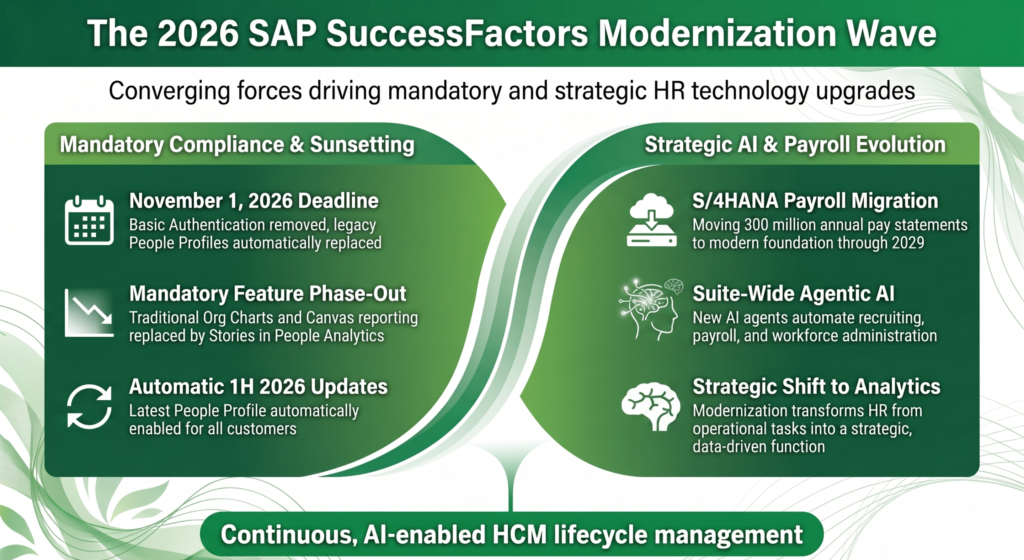
Before exploring the list of companies, it helps to understand the forces driving this wave of upgrades. In 2026, three major factors are converging to accelerate core HR modernization.
The first is the retirement of legacy features. SAP is sunsetting several older components of the platform on a fixed timeline. Basic Authentication will be fully removed by November 1, 2026. The legacy People Profile is being replaced with the Latest People Profile, which will be automatically enabled for all customers with the 1H 2026 release. Older Role-Based Permissions models, traditional Org Charts, and Canvas and Dashboard reporting tools are also being phased out in favor of Stories in People Analytics. These changes are mandatory, not optional. Every organization running SAP SuccessFactors must make these upgrades, which is why so many companies are undertaking them at the same time.
The second force is payroll modernization. SAP has begun migrating Employee Central Payroll the engine behind more than 300 million pay statements annually across 2,000+ companies to a modern S/4HANA technology foundation. This multi-year transformation will continue through 2029, with pilot conversions already completed and the majority of customers expected to begin their migrations from 2027 onward. Because payroll migrations are complex and business-critical, they also drive significant demand for implementation partners, integration services, data migration, and consulting expertise.
The third force is the AI-driven transformation. The SAP SuccessFactors 1H 2026 release significantly expanded suite-wide agentic AI, introducing a connected network of AI agents that support recruiting, workforce administration, payroll, learning, performance, and talent development. New capabilities include the Career and Talent Development Agent, HR Service Agent, Payroll Agent, and People Intelligence Agent. For HR leaders who have long been focused on operational efficiency and administrative tasks, these AI innovations offer a compelling opportunity to transform HR into a more strategic, analytics-driven function making investment attractive even before mandatory upgrade deadlines.
Together, these three forces explain why the conversation around core HR upgrades has changed. Rather than viewing modernization as a one-time implementation project, organizations are increasingly treating it as part of a broader HR transformation strategy. Research firm ISG notes that enterprises are shifting their focus from initial HCM deployments to managing the entire HCM lifecycle, with growing demand for AI-enabled operating models that deliver continuous business value instead of one-time go-lives.
The accounts below are documented SuccessFactors users, each in some stage of modernizing its core HR foundation. They span automotive, technology, energy, manufacturing, retail, and life sciences, which is precisely the firmographic spread that makes this segment valuable for outreach.
Industry: Technology and Professional Services Employees: Approximately 228,000 Annual Revenue: $281.7 billion (FY2025) Headquarters: Redmond, Washington
Microsoft is the textbook example of a core HR upgrade done at scale. The company recently wrapped a multiyear effort to move its core Human Resources systems to SAP SuccessFactors, running the HXM Suite on Microsoft Azure. The goal was to unify a fragmented set of regional and secondary HR systems into one connected platform so employees experience the same Microsoft regardless of country. Microsoft Digital even built custom capabilities on top, such as delivering hire and promotion data in near real time rather than waiting 24 hours. As both a SuccessFactors customer and SAP’s preferred cloud partner, Microsoft’s migration helped pave the Azure path for other SuccessFactors customers.
Why this matters for B2B: A completed core HR migration at this scale signals ongoing spend on integration, analytics, change management, and adjacent HR tech. Accounts that have just unified onto one platform are prime buyers for data enrichment, reporting, and AI-readiness services.
Industry: Automotive Employees: Approximately 640,000 Annual Revenue: ~$380 billion Headquarters: Wolfsburg, Germany
Volkswagen is one of the largest documented users of SAP SuccessFactors Employee Central for core HR. Managing a workforce of this size across dozens of brands and countries makes legacy-feature retirement a serious undertaking, from People Profile migration to the move toward modern authentication and Stories-based analytics. The EU’s tightening pay transparency expectations, which SAP is addressing directly through People Intelligence, add further reason for a German automotive giant to modernize its compensation analytics.
Why this matters for B2B: Large European manufacturers face compliance-driven upgrade pressure earlier than most. They need localized data, multi-country contact intelligence, and partners who understand regulated HR environments.
Industry: Oil, Gas, and Chemicals Employees: Approximately 61,000 Annual Revenue: ~$339 billion Headquarters: Spring, Texas
ExxonMobil runs Employee Central as the foundation for its global HR operations. Energy and chemical firms operate large, distributed, shift-based workforces, which makes them natural candidates for SAP’s newer native Workforce Scheduling module (early adopter January 2026) that connects demand-driven shift planning directly to Time Tracking and Employee Central Payroll.
Why this matters for B2B: Workforce scheduling and time-and-attendance modernization in energy signals investment in operational HR tech, opening doors for adjacent data, analytics, and integration offerings.
Industry: Retail Employees: Approximately 333,000 Annual Revenue: ~$254 billion Headquarters: Issaquah, Washington
Costco uses SAP SuccessFactors Employee Central across a workforce concentrated in high-volume retail operations. Retailers at this scale are heavy users of core HR for employee lifecycle management, from large seasonal hiring waves through offboarding, which makes the recruiting and onboarding side of the suite especially relevant as SAP integrates SmartRecruiters natively into Employee Central and Onboarding.
Why this matters for B2B: Retail HR buyers prioritize speed, scale, and frontline experience. Vendors offering recruiting data, onboarding tools, or workforce analytics have a clear entry point.
Industry: Transportation and Aviation Employees: Approximately 112,000 Annual Revenue: ~$310 billion Headquarters: Dubai, United Arab Emirates
The Emirates Group is a documented Employee Central customer operating one of the most internationally distributed workforces in the world. Aviation and transportation organizations depend on consistent, compliant HR processes across many jurisdictions, exactly the localization strength SAP markets through Employee Central’s 100-plus-country payroll frameworks.
Why this matters for B2B: GCC-headquartered enterprises with global footprints represent high-value, technology-forward accounts. They are strong targets for multi-region data and HR transformation services.
Industry: Medical Devices and Life Sciences Employees: Approximately 14,000 Annual Revenue: ~$3 billion Headquarters: Wayne, Pennsylvania
Teleflex implemented SAP SuccessFactors to gain a single, clear overview of HR operations and standardize processes into one source of truth for HR data. It is a clean example of the mid-market consolidation story: replacing fragmented systems with a governed, unified core.
Why this matters for B2B: Life sciences firms operate under heavy compliance and data-governance requirements. A standardization project signals appetite for verified data and analytics that keep HR audit-ready.
Industry: Chemical Manufacturing Employees: Approximately 26,000 Annual Revenue: ~$8 billion Headquarters: Tokyo, Japan
Resonac modernized its HR management and talent development by implementing SAP SuccessFactors during a major merger, using Succession and Development alongside Employee Central. The result was over 90% succession-planning coverage for leadership roles and a shift to bottom-up talent reviews, with plans to expand globally and lean further into data-driven HR insights.
Why this matters for B2B: Mergers are upgrade accelerants. Newly combined entities consolidate HR systems fast and need data, integration, and talent-analytics support during the transition.
Industry: Travel and Tourism Employees: Approximately 60,000 Headquarters: Hannover, Germany
TUI Group transitioned 37,000 employees onto SAP SuccessFactors using WalkMe as a digital adoption platform, reducing training and support costs in the process. It is a useful proof point that the upgrade story is as much about adoption and experience as it is about back-end migration.
Why this matters for B2B: Large rollouts create demand for digital adoption, training, and change-enablement services. Accounts mid-rollout are receptive to anything that de-risks the transition.
Notice a pattern? Every account above is mid-modernization, which is the moment they are most open to new vendors and data partners. Talk to our team about building a custom list of SuccessFactors accounts by migration stage.
It helps to be specific about what “upgrading core HR tech” actually means within these organizations, because each upgrade represents a different buying motion and sales opportunity.
Mandatory profile and permissions migration is the most universal change. The Latest People Profile becomes mandatory with the 1H 2026 release, while legacy Role-Based Permissions models and traditional Org Charts are being retired. Since every SAP SuccessFactors customer is affected, this represents the broadest near-term trigger for modernization projects.
Payroll stack modernization is the largest and most complex initiative. Migrating Employee Central Payroll to the modern S/4HANA-based foundation is a multi-year, high-investment program that extends through 2029, with most customers expected to begin their migrations from 2027 onward. These projects typically involve long implementation cycles, extensive data migration, system integration, and significant consulting support.
Reporting and analytics modernization is reshaping how organizations use workforce data. Legacy Canvas and Dashboard reports are being replaced by Stories in People Analytics, while People Intelligence in SAP Business Data Cloud introduces AI-driven insights into workforce composition, compensation trends, skills gaps, and attrition risk. For many organizations, this is a shift from static reporting to intelligent, decision-ready analytics.
Agentic AI activation is the voluntary accelerator. The 1H 2026 release introduced connected AI agents across the HR lifecycle, supported by Joule as the conversational AI layer. SAP also launched new AI agents for recruiting, payroll, HR services, talent development, and workforce intelligence. Early adopters such as HR Path have already deployed Joule across their environments in less than a day using SAP’s standardized implementation framework. These initiatives are where forward-looking organizations are investing discretionary budgets to accelerate HR transformation.
Authentication and integration modernization forms the compliance foundation. With Basic Authentication being removed by November 2026 and SOAP-based APIs being phased out in favor of OData services, organizations are also adopting SAP Cloud Identity Services and modern integration architectures to maintain security, compliance, and long-term platform compatibility.
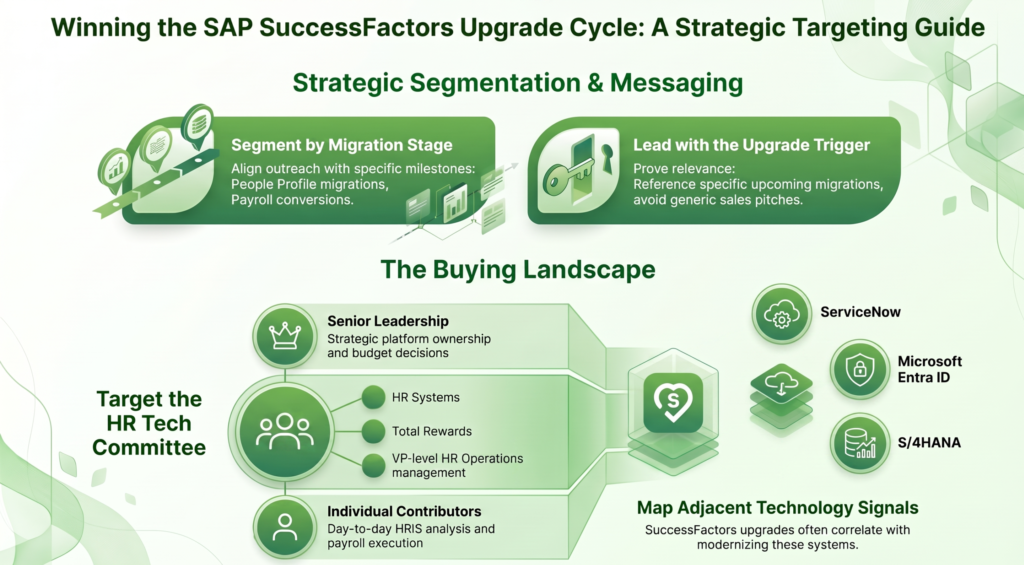
Knowing that thousands of accounts are upgrading is only useful if you can reach the right person at the right point in the curve. A few practical principles apply.
Stop guessing which accounts are in motion.
Span Global Services delivers 100% verified SAP SuccessFactors user data, segmented by module, migration stage, industry, geography, and decision-maker role, so your team reaches buyers while the budget is live.
The companies running SAP SuccessFactors are not standing still. From Microsoft’s completed core HR consolidation to Volkswagen’s compliance-driven analytics push, from ExxonMobil’s shift-based workforce scheduling to Resonac’s merger-led talent overhaul, the entire installed base is moving through a once-in-a-decade modernization cycle. Mandatory migrations are forcing the issue, payroll is being rebuilt on a modern foundation, and agentic AI is giving HR leaders a reason to invest ahead of schedule.
For technology vendors, integrators, and B2B marketers, the takeaway is simple. The accounts are large, the spend is active, and the upgrade itself is the conversation starter. The only missing piece is knowing exactly who is upgrading, what they are upgrading, and how far along they are, and that is precisely where verified technographic data earns its keep.
Reach decision-makers across the SAP SuccessFactors installed base with continuously verified, segmented technology user data.
Explore the Technology Users List RangeTalk to Our Data Team