A product manager at a digital health startup opens her laptop on a Monday morning. She needs to decide where to focus Q3 outreach: the 5 million smartwatch users who want real-time health alerts, or the fast-growing smart ring audience that obsesses over sleep quality and recovery scores. The answer depends on which audience aligns with her product. And that answer lives inside the data.
The Oura Ring vs Apple Watch debate has become one of the most searched wearable comparisons online, with over 6,300 monthly searches in the US alone. But most articles treat this as a consumer buying guide. Which one tracks sleep better? Which has a longer battery?
Those questions matter for shoppers. They miss the bigger picture for businesses.
The real question for B2B marketers, wearable vendors, and health tech companies isn’t which device is better. It’s which user base is more valuable for your product, your campaigns, and your growth strategy.
This guide breaks down Oura Ring vs Apple Watch from a market intelligence perspective, backed by real user data across 20.5 million tracked wearable consumers.
In this article:
The global wearable technology market is projected to reach $109 billion by 2026, growing at a 12.1% CAGR through 2033, according to Grand View Research. Wristwear still leads with roughly 35% of global market share, but the smart ring category is the fastest-growing segment in the industry. For businesses looking to understand how this growth translates into targetable audiences, wearable technology user data provides the foundation.
Here’s how the numbers break down across major wearable categories:
| Category | Tracked Users | Market Share |
| Smartwatches | 5,073,164 | 24.7% |
| Fitness & Activity Trackers | 3,116,257 | 15.2% |
| Smart Glasses & Head-Mounted Devices | 3,082,349 | 15.0% |
| Health Monitoring Wearables | 2,275,138 | 11.1% |
| Medical / Clinical Wearables | 2,246,137 | 10.9% |
| Smart Clothing & Accessories | 1,252,518 | 6.1% |
| Specialized Wellness Wearables | 1,028,173 | 5.0% |
| Stress & Mental Well-Being Wearables | 861,709 | 4.2% |
| Sleep & Recovery Wearables | 816,852 | 4.0% |
| AR / VR Fitness Wearables | 810,453 | 3.9% |
Smartwatches lead in total users. But the growth story is happening elsewhere. Smart rings, sleep trackers, and stress monitoring wearables are collectively growing 25 to 30% year over year, compared to 8 to 12% for established categories like smartwatches and fitness bands.
That growth rate is what makes the Oura Ring vs Apple Watch comparison interesting beyond the spec sheet.
Rather than rehash every feature, here’s a focused comparison on the capabilities that matter most for health tracking in 2026.
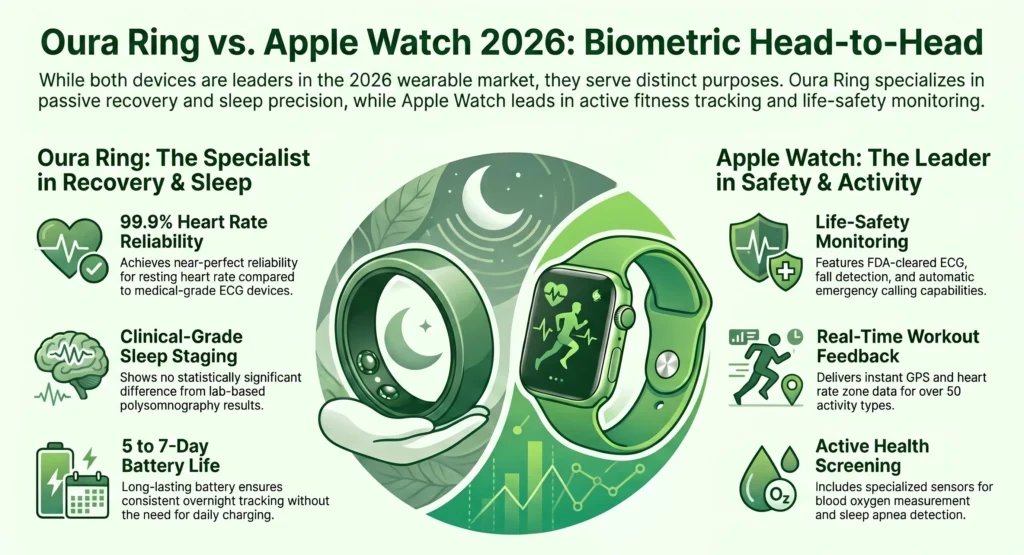
A 2024 study published in Sensors compared both devices against polysomnography (the clinical gold standard for sleep measurement). The Oura Ring’s sleep staging showed no statistically significant difference from lab results across wake, light sleep, deep sleep, and REM stages. The Apple Watch improved with recent watchOS updates, but still underestimates wake time and deep sleep while overestimating light sleep.
Oura provides a daily Sleep Score (0 to 100) factoring in total duration, efficiency, restfulness, and individual stage time. It also tracks sleep consistency and chronotype patterns. The Apple Watch tracks sleep duration and stages but doesn’t build the same depth of analysis around the data.
Key stat: Oura Ring achieves 99.9% reliability for resting heart rate measurement when compared to medical-grade ECG devices.
The Apple Watch offers FDA-cleared ECG monitoring, blood oxygen measurement, sleep apnea detection (Series 10/9), and fall detection with automatic emergency calling. These are life-safety features that no smart ring currently matches.
Apple Watch also excels at real-time workout tracking with GPS, heart rate zones, and structured workout modes for over 50 activity types. If a user needs instant feedback during a run or cycling session, the Apple Watch delivers it directly on the wrist.
Oura generates three daily scores: Readiness, Sleep, and Activity. The Readiness Score synthesizes overnight HRV, body temperature trends, resting heart rate, and sleep quality into a single metric that tells you whether to push hard or take it easy.
The Apple Watch introduced its Vitals app to track health baselines. It monitors breathing rate, temperature, sleep, and resting heart rate. But it doesn’t synthesize these into a clear, actionable readiness signal the way Oura does.
This one isn’t close. The Oura Ring lasts 5 to 7 days on a single charge. The Apple Watch typically needs daily charging, sometimes more with heavy workout tracking. For overnight health monitoring, Oura’s battery advantage is significant. If a device is charging on the nightstand, it’s not tracking your sleep.
| Feature | Oura Ring 4 | Apple Watch Series 10 |
| Sleep Tracking Accuracy | Clinically validated, polysomnography-grade | Good, improving with each update |
| ECG / Medical Alerts | Not available | FDA-cleared ECG, sleep apnea, fall detection |
| Readiness / Recovery Score | Daily score with actionable insights | Vitals app tracks baselines but no single score |
| Real-Time Workout Tracking | Limited, manual input for many activities | Comprehensive with GPS, 50+ workout modes |
| Battery Life | 5 to 7 days | 18 to 36 hours |
| Form Factor | Ring, 2.8 to 4.0g, screen-free | Watch, 32 to 39g, touchscreen |
| Price (3-year cost) | ~$565 (device + $5.99/mo subscription) | $399 to $799 (no subscription) |
| Best For | Passive health monitoring, sleep, recovery | Active fitness, safety features, daily smartwatch use |
Looking to target smartwatch or smart ring users specifically? Span Global’s wearable technology users database segments 20.5M+ consumers across 10 device categories. Get a free data sample →
Here’s where the B2B angle gets interesting. The Oura Ring and Apple Watch don’t just differ in features. They attract fundamentally different users with different behaviors, priorities, and spending patterns.
Oura’s user base skews toward wellness-focused professionals aged 30 to 50 who prioritize sleep quality, stress management, and long-term health optimization. These users tend to be:
Oura has sold 2.5 million units globally and raised $900 million in funding in 2025 alone.
Apple Watch users span a much broader demographic, from college students tracking workouts to executives managing notifications. The health-focused segment within that base tends to be:
The Apple Watch remains the world’s most popular wearable, and smartwatches as a category represent over 5 million tracked users.
If you’re a digital health company marketing a sleep optimization app, the Oura audience is your primary target. If you’re selling workplace safety wearables or real-time health alert systems, Apple Watch users are more aligned. Understanding these segments at the contact level is where technology user intelligence becomes a competitive advantage.
The audience composition determines your campaign strategy, your messaging, and ultimately your conversion rates. Generic “wearable users” targeting wastes budget. Segment-level targeting, informed by verified, enriched data, drives results.
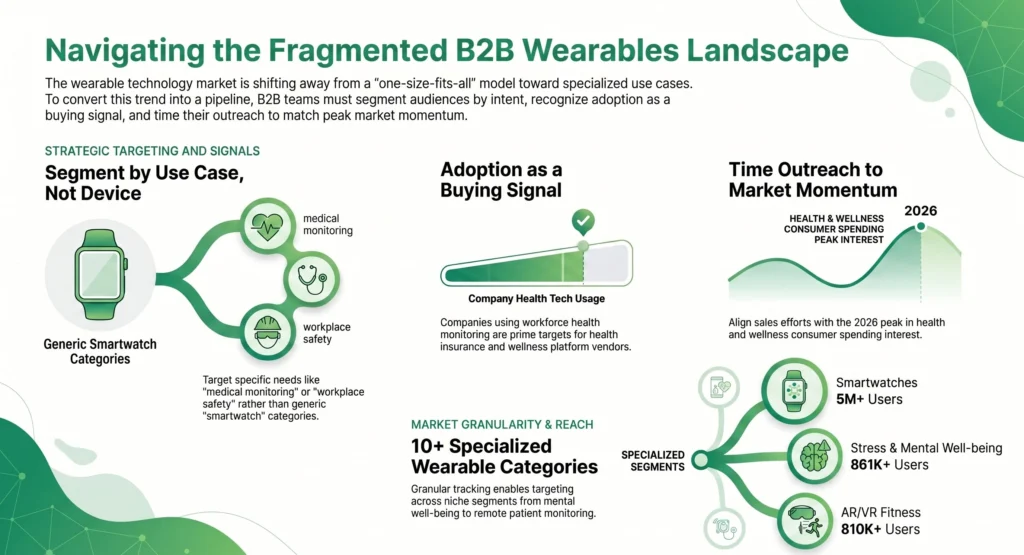
The Oura Ring vs Apple Watch split reflects a larger market trend: wearable technology is fragmenting into specialized use cases. One-size-fits-all approaches to reaching wearable users don’t work anymore.
Here are three implications for B2B teams:
The categories that matter aren’t “smartwatch vs smart ring.” They’re “active fitness vs passive wellness vs medical monitoring vs workplace safety.” Each of these segments has different decision makers, different pain points, and different buying timelines.
Span Global tracks users across 10 distinct wearable categories, from smartwatches (5M+) to AR/VR fitness (810K+) to stress and mental well-being wearables (861K+). That granularity enables campaign targeting that generic tech lists can’t match.
A company that recently adopted wearable health monitoring for its workforce is signaling investment in employee wellness. That’s a buying signal for health insurance providers, corporate wellness platforms, EAP vendors, and health data analytics companies.
Similarly, a healthcare provider integrating remote patient monitoring wearables is actively seeking data enrichment, compliance tools, and integration partners. Identifying these signals early through verified industry data gives your sales team a head start.
Wearable technology searches spiked significantly in early 2026, with Oura and Garmin leading the growth in consumer interest, according to a MediaVision SEO report. Health and wellness was the only spending category where American consumers planned to increase spend in 2026.
Riding that momentum with targeted outreach to wearable-adjacent decision makers, while interest is peaking, is how B2B teams convert market trends into pipeline.
Whether you’re choosing a wearable for personal use or building a campaign to reach wearable users, the framework is the same:
Step 1: Define the outcome you’re optimizing for. Sleep and recovery? Oura Ring. Real-time fitness and safety? Apple Watch. Comprehensive monitoring? Consider both.
Step 2: Understand the user behind the device. Oura users skew toward high-income wellness enthusiasts who consume health content and invest in optimization tools. Apple Watch users span broader demographics with emphasis on active lifestyles and ecosystem integration.
Step 3: Match your product or message to the segment. Don’t market a sleep app to a fitness-first audience. Don’t pitch workplace safety tools to the biohacking community. Let the data guide the match.
Step 4: Use verified user intelligence to target precisely. Generic wearable targeting is expensive and inefficient. Segment-level targeting based on actual device adoption, user demographics, and behavioral patterns is what separates high-ROI campaigns from spray-and-pray. Tools like custom list building and data appending make this operational, not theoretical.
Yes, based on current research. A 2024 study in Sensors found that the Oura Ring’s sleep staging closely matched polysomnography (the clinical gold standard), with no statistically significant differences across wake, light, deep, and REM stages. The Apple Watch has improved significantly with each watchOS update but still shows some variance in deep sleep and wake time detection. If sleep quality and recovery insights are your primary goal, the Oura Ring currently offers more depth and accuracy.
Absolutely. In fact, 40% of Oura Ring users also own an Apple Watch, according to Wareable. The two devices complement each other well: use the Oura Ring for passive overnight tracking (sleep, recovery, readiness) and the Apple Watch for real-time workout feedback, notifications, and safety features. Oura syncs with Apple Health, so data from both devices can be centralized in one dashboard. For businesses building apps or services in the wearable ecosystem, understanding this overlap is critical for targeting the right audience.
The Apple Watch has a clear advantage here. It includes an FDA-cleared ECG monitor that detects irregular heart rhythms like atrial fibrillation, blood oxygen tracking, and sleep apnea detection. The Oura Ring tracks resting heart rate with 99.9% reliability and provides detailed HRV analysis, but it does not offer ECG or real-time cardiac alerts. For users with known heart conditions or those prioritizing medical-grade monitoring, the Apple Watch is the stronger choice.
The global wearable technology market is projected to reach $109 billion in 2026, growing at a 12.1% CAGR through 2033. Smartwatches hold approximately 46% of market share by revenue, while smart rings and health monitoring wearables are the fastest-growing segments at 25 to 30% annual growth. Span Global Services tracks over 20.5 million wearable device users across 10 categories, providing the market intelligence that B2B teams need to target this expanding market.
Wearable adoption data functions as a powerful buying signal. A company deploying health wearables for employees signals investment in workplace wellness, making them a prospect for insurance providers, HR tech vendors, and wellness platforms. Segment-level data (smartwatch vs smart ring vs medical wearable users) enables precise email marketing and account-based marketing campaigns. Rather than targeting “wearable users” broadly, verified technology user lists let you match your ICP to specific device categories and job titles.
Want to see what verified wearable user data looks like? Request a free sample from Span Global’s wearable technology database →
The Oura Ring vs Apple Watch debate doesn’t have a universal winner. Both devices excel in their respective domains. The Oura Ring delivers clinically validated sleep and recovery tracking in a form factor you forget you’re wearing. The Apple Watch combines comprehensive health features with smartwatch functionality and life-safety alerts.
For B2B marketers and wearable vendors, the more important question is: which audience do you need to reach, and do you have the data to reach them precisely?
Span Global Services tracks over 20.5 million wearable technology users across 10 device categories, providing verified, segmented user intelligence that transforms how companies target the wearable market.