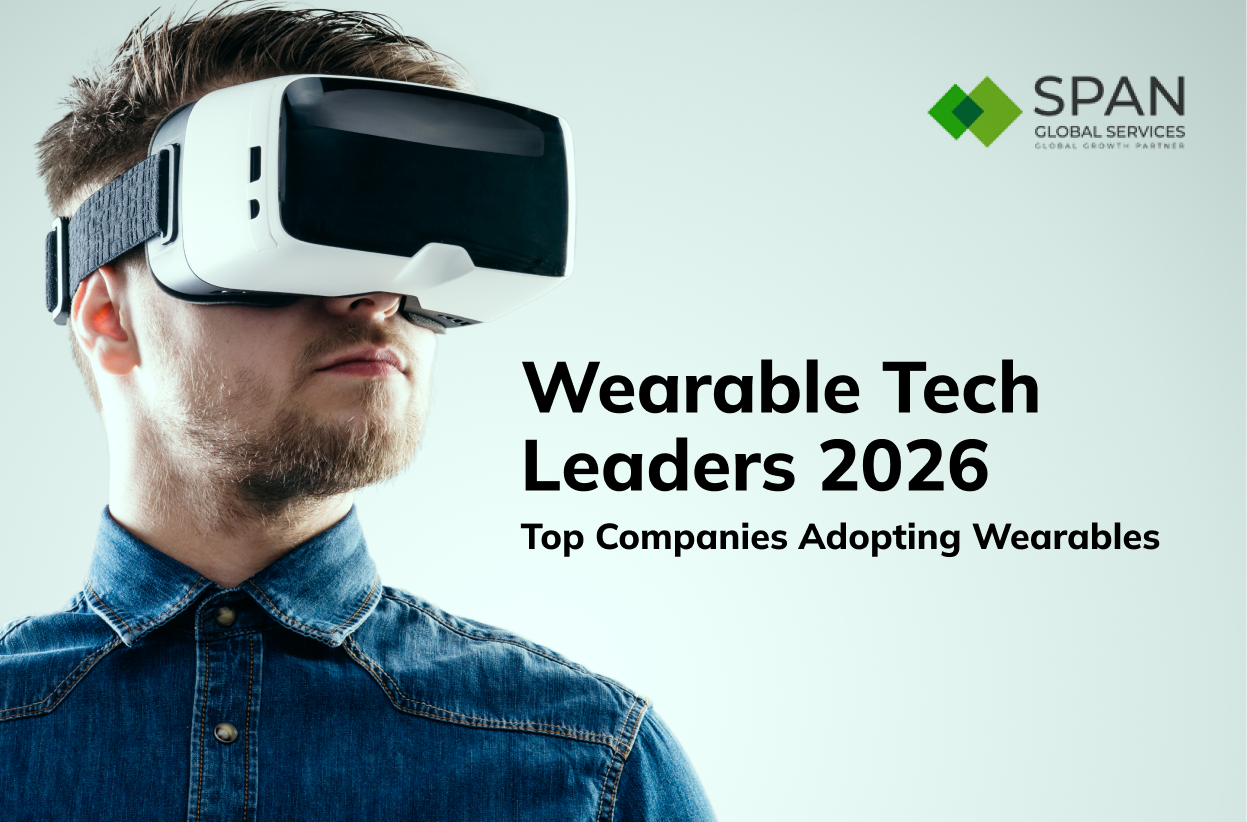
Wearable technology has moved out of the fitness tracker conversation and into the enterprise zone. In 2026, some of the world’s largest companies are deploying smartwatches, smart glasses, exoskeletons, biometric sensors, and smart helmets at scale to reduce workplace injuries, cut healthcare costs, and give their workers superhuman precision.
The global enterprise wearable services market is projected to grow from $66.5 billion in 2026 to over $2.6 trillion by 2035. This is no longer about consumer gadgets. This is about operations, safety, and productivity at a Fortune 500 scale.
For B2B marketers and sales teams, these deployments signal exactly which companies are investing in digital transformation, employee health, and IoT infrastructure. Layering intent data into your B2B sales strategy helps you reach these companies when they are actively evaluating complementary solutions.
Hence, we have listed out the top companies using wearable technology in 2026 and what their deployments reveal about the B2B opportunity.
Boeing has integrated wearable technology deeply into its aircraft manufacturing process. The company deploys Boeing VisionAR and Boeing Torque-Ready smart glasses that guide technicians through electrical assembly and wire harness routing. These AR devices display schematic overlays directly in the technician’s field of view, reducing documentation errors and cutting wiring task times by up to 25%.
The business case is precise. A single aircraft contains hundreds of miles of wiring, and a single misrouted cable can cascade into millions in rework. Wearables fix that.
Why this matters for B2B: Boeing’s deployment signals massive investment in manufacturing AR, digital twin infrastructure, and MES integration. If you sell industrial IoT, AR software, or manufacturing analytics, aerospace and defense manufacturers are prime targets.
BP deploys wearable technology across its offshore operations to protect workers from fatigue, heat stress, and hazardous environments. Smart helmets and biometric vests monitor heart rate variability, body temperature, and environmental conditions in real time, flagging workers at risk before an accident happens.
The results have been significant. BP has reduced workplace accidents and improved retention in hazardous roles, addressing a critical challenge in oil and gas where workplace injury costs exceed $60 billion annually in the US alone.
Why this matters for B2B: Oil and gas, mining, chemicals, and heavy industrial verticals are among the fastest adopters of safety wearables. Buyers include HSE directors, operations VPs, and risk management executives. An account-based marketing approach with 100% verified contacts from this company works especially well for multi-stakeholder deals.
Amazon has deployed wearable scanners, proximity sensors, and RFID wristbands across its fulfillment centers globally. These devices track inventory movements, guide pickers to the correct bins, and alert workers (and their equipment operators) when they come within range of forklifts and other heavy machinery.
The company has also invested in vibration-based feedback wearables that signal errors without requiring a worker to stop and check a screen. While Amazon’s wearable deployments have drawn scrutiny over worker privacy, the operational results, faster picking, fewer accidents, and higher throughput, have made the company a reference deployment for warehouse automation.
Why this matters for B2B: Amazon’s scale signals opportunity across its vendor ecosystem. Logistics software providers, warehouse management system vendors, and worker safety platforms all have adjacent entry points into this market.
Walmart uses wearables to streamline store operations and improve associate efficiency. The company deploys smartwatches and voice-activated headsets to help floor associates check inventory, respond to customer requests, and coordinate with backroom teams, all without leaving the customer.
Walmart has also tested biometric wearables for warehouse employees to monitor fatigue and ergonomic strain during high-volume periods.
Why this matters for B2B: Retail wearable deployments depend on underlying technology stacks, from inventory management systems to HR platforms like BambooHR and workforce scheduling software. Every layer represents a targeting opportunity.
Target is one of the largest and earliest adopters of employee wellness wearables. The retailer made Fitbit devices available to over 335,000 US employees as part of a team-based wellness competition, with the winning team choosing to donate $1 million to charity.
The program reduced healthcare costs and increased employee engagement, making Target a case study in how retail giants use wearables as a benefits differentiator.
Why this matters for B2B: Corporate wellness programs are a recurring budget line at large retailers. HR benefits leaders, total rewards directors, and employee experience VPs are active buyers for wellness platforms, health analytics, and employee engagement tools.
PwC brought wearable technology into its consulting workforce through a comprehensive wellness initiative. The firm deployed fitness trackers and gamified team challenges, encouraging employees to track activity, sleep, and stress levels across offices globally.
The program went beyond step counting. PwC used wearable data to inform its return-to-office strategy, workload distribution, and mental health support, reporting measurable reductions in burnout indicators and healthcare utilization.
Why this matters for B2B: Professional services firms often serve as early adopters whose employee programs influence their clients. If you sell into HR tech, employee analytics, or corporate wellness, a PwC-style deployment is the reference story that opens doors at law firms, accounting firms, and consultancies.
Bank of America deployed smart badges at its Rhode Island operations center to measure employee movement and team interaction patterns. The data gave workplace strategy teams concrete evidence of how collaboration actually happened versus how it was assumed to happen, leading to measurable redesigns of team layouts and meeting patterns.
This use case pioneered what is now called workplace analytics, using wearables to generate aggregated, anonymized insights that drive real estate, collaboration, and productivity decisions.
Why this matters for B2B: Financial services firms tend to be technology-forward and budget-rich. Wearable deployments at banks signal investment in cloud infrastructure like AWS, workplace analytics platforms, and cybersecurity solutions, all adjacent B2B targeting opportunities.
Delta has equipped its ground crews with wearable scanners and smart gloves that speed up baggage handling and reduce errors. The gloves include ring scanners that free up both hands for lifting and sorting, cutting turnaround time during tight connection windows.
Delta has also piloted smartwatches for gate agents, enabling faster communication during irregular operations like weather delays and equipment swaps.
Why this matters for B2B: Aviation wearable deployments signal technology investment in ground operations, a notoriously complex vertical. Selling software, data, or managed services to airlines requires understanding their operations complexity, which wearable adoption data helps reveal.
Lufthansa Technik uses voice-based wearable headphones to help aircraft maintenance technicians execute complex inspection checklists hands-free. Technicians receive instructions through the headset, confirm completion via voice, and the system logs everything automatically, reducing manual paperwork by over 40%.
This is one of the most mature industrial voice-wearable deployments globally.
Why this matters for B2B: Aviation MRO (maintenance, repair, and overhaul) is a multi-billion-dollar industry where digital transformation is accelerating. Wearable adoption signals openness to AI-driven workflow tools, asset management platforms, and predictive maintenance solutions.
DHL pioneered “vision picking” in warehouses by equipping pickers with smart glasses that display picking instructions directly in the line of sight. This replaced paper lists and handheld scanners, increasing picking efficiency by 15-25% and cutting training time for new hires dramatically.
DHL has scaled this across multiple distribution centers and continues to invest in AR-based workflows.
Why this matters for B2B: Third-party logistics providers (3PLs) are a fast-growing segment adopting wearables. Their technology stacks overlap with manufacturing and retail verticals, making them high-value targets for technographic data-driven prospecting.
Ford has rolled out upper-body exoskeletons (EksoVest) to its assembly line workers at multiple plants. The device supports workers performing overhead tasks, reducing strain on shoulders, backs, and necks during repetitive work like installing vehicle ceiling components.
Ford has reported meaningful reductions in musculoskeletal injuries and associated workers’ compensation claims.
Why this matters for B2B: Automotive, aerospace, and heavy manufacturing are prime markets for industrial wearables. Companies investing in exoskeletons are also typically investing in predictive ergonomics software, workplace safety analytics, and insurance technology.
Several other companies are running meaningful wearable programs worth monitoring:
Hitachi uses smart badges to analyze workplace interaction patterns and inform organizational design decisions.
Barclays rolled out subsidized Fitbit trackers to over 75,000 employees globally as part of its Global Wellness Program, and later expanded across all 140,000 employees worldwide.
GoDaddy, Emory University, and Emory Healthcare have deployed Fitbit corporate programs to tie employee health outcomes to benefits strategy.
UPS has tested wearable scanners and biometric monitors for delivery drivers to reduce injury rates.
Chevron uses connected hard hats and environmental sensors in refinery operations.

Companies deploying wearable technology are signaling something much bigger than a device rollout. They are telling the market they have a budget for digital transformation, data infrastructure, and employee experience investments. The professionals making these decisions, CHROs, Chief Safety Officers, CIOs, and VPs of Operations, are exactly the buyers most B2B teams want to reach.
Here is how to activate this insight:
Map wearable deployers to your ICP. Companies using wearables are often the same companies investing in cloud platforms, HR tech, cybersecurity, and analytics. Build account lists that cross-reference wearable adoption with your primary technology signals.
Target by use case, not by industry. A retail giant using wearables for employee wellness looks different from a manufacturer using exoskeletons. Segment your outreach around the specific use case (safety, wellness, productivity, operations) rather than broad vertical categories. Data appending and enrichment help you layer these signals onto your existing database.
Activate in the buying window. Wearable deployments often happen in phases. Companies running pilots in 2025 often scale in 2026-2027. That expansion moment is when they buy complementary solutions. AI-powered intent data signals exactly when that window opens.
Span Global Services helps B2B teams identify and reach technology decision-makers across companies using wearable technology at scale. As one of the top B2B technology database providers in the US, our verified contact databases, intent data, and technographic intelligence give you the precision targeting you need to turn market intelligence into pipeline.
Major enterprise deployers in 2026 include Boeing (smart glasses for aircraft assembly), BP (safety wearables on oil rigs), Amazon and Walmart (warehouse wearables), Target and PwC (corporate wellness programs), Bank of America (workplace analytics), Delta and Lufthansa (aviation operations), DHL (vision picking), and Ford (exoskeletons on assembly lines).
The top three drivers are worker safety (reducing injuries and workers’ compensation costs), productivity (faster, more accurate task completion), and employee wellness (lowering healthcare costs and improving engagement). Industries with high injury rates or complex manual workflows see the fastest ROI.
Manufacturing, logistics, oil and gas, aerospace, healthcare, retail, and financial services lead enterprise adoption. Warehousing, construction, and field services are experiencing the fastest growth. Many of these same industries are also among the top users of managed service providers for their broader IT infrastructure needs.
The most common enterprise wearables are smart glasses (AR instructions and vision picking), smart helmets and vests (safety and biometric monitoring), smartwatches (communication and wellness tracking), ring scanners and smart gloves (warehouse operations), exoskeletons (ergonomic support), and smart badges (workplace analytics).
The top vendors of wearable technology products in 2026 include Apple, Meta Platforms, Garmin, and Samsung.
B2B marketers can use technographic and intent data from a 100% verified wearable technology users list to identify companies actively using wearables, then align their outreach to decision-makers in HR, operations, safety, and IT. Explore the best B2B intent data platforms to find the right tool for your team.