

The construction industry is in the middle of a technological revolution and companies that ignore it are paying the price. Construction projects that rely on disconnected tools lose up to 17% of labor hours to rework and miscommunication, according to a 2025 Dodge Construction Network report. In 2026, choosing the right construction management software is no longer an operational preference. It is a direct determinant of whether a firm hits its margin targets or bleeds cash on every job.
The construction management software market is projected to expand from USD 10.62 billion in 2025 to USD 11.58 billion in 2026, growing at an 8.99% CAGR and expected to reach USD 17.81 billion by 2031. This growth is no accident, and companies using construction software is seeing growth and better organization’s productivity. The construction industry needs approximately 499,000 additional workers in 2026, and 82% of firms struggle to find hourly craft workers. When you can’t hire fast enough, software becomes less of a nice-to-have and more of a survival tool.
This guide covers everything you need to know: the top platforms, their features, pricing, ideal use cases, and the key trends shaping the market in 2026.
Before diving into the platforms themselves, it helps to understand the macro forces shaping the market.
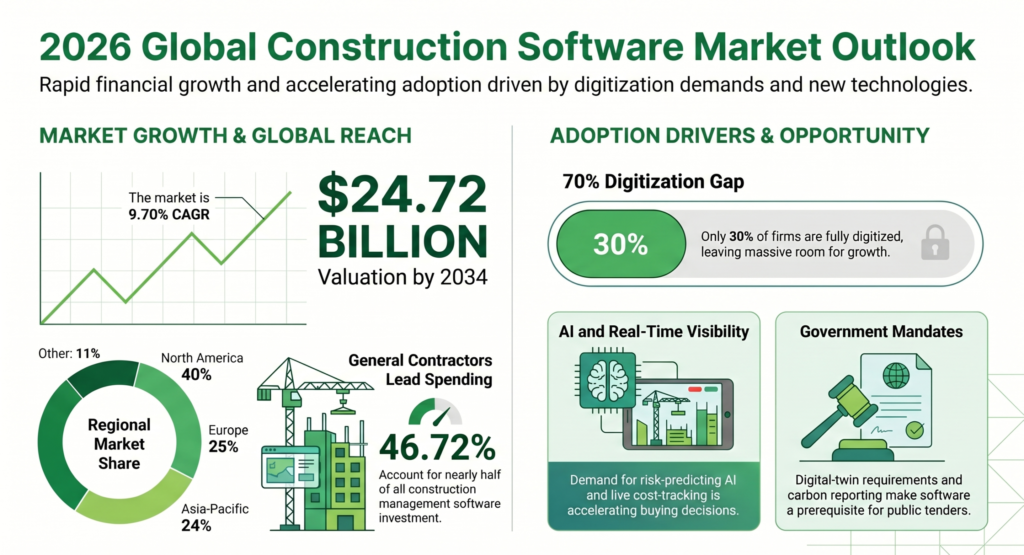
The global construction software market was valued at USD 10.76 billion in 2025 and is projected to grow to USD 11.78 billion in 2026, and then to USD 24.72 billion by 2034, exhibiting a CAGR of 9.70% during the forecast period.
North America leads with 40% market share due to advanced digital adoption and seeing a significant raise in the list of companies using construction management software. Europe follows with 25% driven by regulatory integration requirements. Asia-Pacific holds 24%, fueled by major infrastructure digitalization initiatives.
Despite the market’s rapid growth, only around 30% of construction firms are fully digitized, leaving an enormous opportunity for technology adoption across the sector. The firms that do adopt software are gaining a significant competitive edge.
Owners now demand real-time cost and schedule visibility that connects design intent with field execution, a shift that accelerates buying decisions when large projects face labor shortages and material volatility. Vendors are embedding AI modules that predict risk and automate compliance documentation, easing the talent gap that has widened as veteran project managers retire. Governments on every continent have reinforced demand through tax incentives, embodied-carbon reporting mandates, and digital-twin requirements that make software a prerequisite for public tenders.
Nearly three-quarters of construction firms plan to increase software spending in 2026, influenced by the top companies using construction software, and with general contractors representing 46.72% of construction management software spending.
Here is a comprehensive breakdown of the leading platforms, who they serve, and what makes each one stand out.
Best for: Large general contractors, commercial builders, enterprise firms
Procore is the undisputed market leader in construction management software. Procore offers a large subcontractor network with over 1.6 million connected companies on its platform, which benefits general contractors focused on bid solicitation.
Procore’s platform includes resource management tools for workforce allocation, equipment utilization, and crew scheduling. Analytics and reporting features consolidate project and portfolio data into a centralized system. Procore AI, powered by the Datagrid agentic AI platform, automates routine tasks and offers predictive insights to support construction decision-making. The platform includes mobile applications for iOS and Android devices and maintains FedRAMP Moderate Authorization for government construction projects.
Procore’s AI suite includes automated agents for scheduling and RFIs, a generative AI Copilot for searching project data and summarizing documents, and an Agent Studio for creating custom AI tools without code.
The platform is cloud-hosted. All plans include unlimited projects, storage, and users, and it integrates with more than 500 third-party applications, including QuickBooks Pro, Sage 100 Contractor, Sage 300, Viewpoint Vista, and Microsoft Teams.
Unlike many SaaS tools, Procore doesn’t publish a standard price list. Pricing is based on Annual Construction Volume (ACV), the total dollar value of projects handled in a year. Starting costs are around $10,000 per year. For large enterprise firms managing $100M+ in annual volume, costs range from $15,000 to $100,000+ per year.
Large commercial general contractors with $10M+ projects will find Procore’s enterprise feature set and drawing control worth the cost. Construction software user’s database features Procore as the most leveraged software in this industry.
Analyst Rating: 87/100 (SelectHub)
Best for: Design-build firms, large commercial contractors, AEC professionals
Autodesk Construction Cloud is the go-to platform for teams deeply embedded in BIM workflows and the broader Autodesk ecosystem. It bridges the gap between design and construction more effectively than any other platform.
Autodesk Construction Cloud provides a centralized project hub for drawings, documents, and updates, keeping office and field teams aligned. Mobile field access lets crews view plans, file reports, and handle RFIs or punch items from tablets or phones, with changes synced to the main system.
Autodesk has made a pivotal change in its cloud architecture, replacing legacy ZIP-based downloads for Revit Cloud Models with a restructured “Signed URL” workflow via Autodesk Platform Services, improving collaboration speeds significantly.
Autodesk pricing benchmarks place licenses at $4,000–$6,000 per year for firms with less than $10 million in active work, and $10,000–$15,000 for builders with a $10–$100 million backlog.
Autodesk’s catalog is large, and it’s possible to double-pay for overlapping modules. The cost module lacks the depth of a full construction ERP, so many general contractors export to Sage or CMiC. For firms already deep in Autodesk design tools, Build gives a quick path from a 3D model to the job site.
Ideal for design-build firms and BIM-heavy projects.
Best for: Residential builders, remodelers, small-to-mid-sized contractors
Builder trend is the leading platform for residential construction, with a strong focus on client communication, ease of use, and affordability.
Buildertrend is project management software with over 1 million users worldwide. The user-friendly, cloud-based software eases communication for all construction project stakeholders, ensuring projects are completed on time and within budget. Its mission is to bring order and efficiency to the construction process by empowering residential contractors with a better way to run their business.
Buildertrend features mobile capabilities for accessing job details, submitting daily reports, and approving change orders from the field. Customizable dashboards provide key project performance metrics for quick, informed decisions.
Buildertrend offers pricing from $99 to $399 per month with a 2–4 week setup timeline.
For contractors considering Buildertrend: once your information is inside their system, retrieving it later is a significant challenge. Data portability should be evaluated carefully if you anticipate switching platforms in the future.
Buildertrend specializes in supporting small to medium-sized residential builders and remodelers. It is better than Procore when it comes to features specific to residential builders, and is considerably less expensive.
Analyst Rating: 83/100 (SelectHub)
Best for: Large general contractors, ENR-ranked firms, complex multi-project portfolios
CMiC is one of the most comprehensive construction ERP platforms available, designed to connect every financial and operational workflow in a single system.
CMiC offers a unified, purpose-built ERP and field management software platform for companies that serve the construction industry. It covers project management, financials, HR, payroll, equipment management, business intelligence, and field operations, all in one integrated suite. CMiC is particularly well-regarded for its deep financial controls, job costing accuracy, and ability to handle complex multi-entity accounting across large contractor organizations.
CMiC’s platform supports digital twin technology integration, APIs for seamless software interoperability, and open API functionality that facilitates the integration of third-party tools, enabling customization without overhauling existing systems.
CMiC is best suited for ENR-ranked firms and large general contractors who need a single source of truth across finance, operations, and field. It competes directly with Procore at the enterprise level but with a stronger ERP backbone.
Best for: Structural engineers, steel fabricators, heavy civil contractors
Trimble’s suite of construction tools, including Tekla Structures and Viewpoint, serves both the design-engineering side and the operational side of construction.
Trimble introduced the 2026 version of its Tekla software for constructible BIM, structural engineering, and steel fabrication management, delivering data-driven workflows that connect design and construction. The release introduces “AI Cloud Fabrication Drawings,” a human-in-the-loop AI service that uses user-defined drawing libraries from past projects to automatically generate fabrication drawings.
Viewpoint Vista and Viewpoint Team complement Tekla by providing accounting, payroll, HR, and field data collection for contractors in the field.
Trimble is ideal for structural engineering firms, steel fabricators, and heavy civil contractors who need a deep, constructible BIM workflow paired with solid ERP capabilities.
Best for: Mid-to-large contractors seeking robust accounting and job costing
Sage is one of the most trusted names in construction accounting. Its flagship products , Sage 100 Contractor and Sage 300 Construction and Real Estate , handle everything from job costing and payroll to subcontractor compliance and general ledger management.
Sage integrates natively with many of the platforms on this list. Procore integrates with Sage 300 Construction and Real Estate, allowing seamless exchange of financial data across both systems. Sage’s strength lies in its financial depth: certified payroll, union payroll, AIA billing, lien waiver management, and detailed job cost reporting are all core to the platform.
Construction companies that prioritize financial visibility, cost accounting, and regulatory compliance will find Sage difficult to beat. It’s particularly popular among mid-size to large commercial general contractors and subcontractors.
Best for: Infrastructure, transportation, energy, and mega-project owners and contractors
Oracle Aconex is the gold standard for document management and project controls on large-scale, high-stakes infrastructure projects.
Oracle Aconex serves as the documentation backbone for large terminals, rail corridors, and LNG plants, where every RFI and transmittal needs a forensic audit trail.
Aconex provides a neutral, owner-managed Common Data Environment (CDE) where all project participants , owners, GCs, subcontractors, consultants can collaborate without one party controlling the platform. Its audit trail capabilities make it indispensable on projects with regulatory and legal exposure.
Oracle prices Aconex by custom quote, but analyst and reseller data suggest user licenses start at around $49 per user per month at low volumes, sliding to $29 per user once you pass 1,000 accounts.
Best for infrastructure owners and program managers on mega-projects where contractual document management and full auditability are non-negotiable.
Best for: Field superintendents, subcontractors, task-focused teams
Fieldwire is a field-first platform built for the people actually on the job site: foremen, superintendents, and trade contractors who need fast access to drawings, tasks, and inspections from their phones.
Fieldwire provides a free tier for up to 5 users focused on task management and plan viewing, though it lacks financial features. Paid tiers add punch lists, inspections, RFIs, reports, and offline mode. Its real strength is simplicity , it’s easy to onboard field crews who aren’t tech-savvy.
Fieldwire offers a useful free tier for field teams that focus on task management and collaboration. It’s an excellent starting point for subcontractors or field teams that don’t need full project management or financial capabilities.
Best for: Small contractors and growing firms on a tight budget
Contractor Foreman offers plans starting at $49/month for up to 3 users, making it one of the cheapest options with legitimate project tracking.
Despite the low price point, Contractor Foreman covers a wide range of features including estimates, scheduling, daily logs, invoicing, RFIs, punch lists, and client portals. It punches well above its weight class for small firms that find enterprise platforms overwhelming and overpriced.
Small and mid-size contractors under $5M annual volume will find strong feature coverage without enterprise pricing in platforms like Contractor Foreman.
Best for: Residential and light commercial contractors
JobTread is one of the fastest-growing construction software platforms for smaller contractors who want clean, connected financials built directly into their project management workflow.
It combines estimating, budgeting, job costing, scheduling, and customer communication in a single, affordable interface. Unlike many competitors at its price point, JobTread was built with financial control at its core not bolted on as an afterthought.
Small and mid-size contractors under $5M annual volume will find JobTread delivers strong feature coverage without enterprise pricing. It’s particularly suited to builders who have outgrown spreadsheets but don’t yet need the complexity of Procore or Autodesk.
Best for: Specialty trade contractors (electrical, plumbing, HVAC, mechanical)
Knowify serves trade contractors with a purpose-built platform that handles the unique billing and job costing workflows of specialty trades. It covers T&M billing, contract management, scheduling, and integrates cleanly with QuickBooks, a combination that resonates strongly with small trade businesses.
Electrical, plumbing, HVAC, and mechanical contractors who need software that understands their billing models and integrates with their existing accounting tools.
Best for: Subcontractors and specialty contractors
eSUB is purpose-built for subcontractors who are tired of being an afterthought in platforms designed for general contractors. It focuses on field-to-office connectivity, RFI and submittal management, daily reports, and T&M tracking , exactly what subs need.
eSUB specializes in subcontractor management and is recognized as one of the top platforms for this use case in 2026.
Mechanical, electrical, plumbing, drywall, concrete, and other specialty subcontractors who want a platform built around their workflows, not adapted from a GC-centric tool.
Best for: Small-to-mid contractors needing serious accounting depth
Foundation Software brings an accounting focus as one of the top-ranked construction platforms in 2026. It covers job costing, payroll, accounts payable/receivable, general ledger, and equipment management with a depth that rivals much larger ERP systems. It’s often the first serious accounting upgrade for contractors moving off QuickBooks.
Best for: Construction firms focused on tight cost control and subcontractor cost management
Archdesk takes a different approach by tying subcontractor workflows directly to budgets, purchase orders, and real-time margin tracking at the task level. For firms where controlling subcontractor costs matters more than sourcing new subs, Archdesk provides tighter financial visibility without requiring a separate accounting integration.
Best for: Residential remodeling contractors, interior designers, and design-build firms Houzz Pro is a specialized project management and marketing tool tailored for the residential space.
It provides a unique visual dashboard where contractors can share 3D floor plans, mood boards, and product selections with clients. Beyond project tracking and invoicing, it integrates lead generation and a customer relationship management (CRM) system tied directly to the Houzz homeowner marketplace.
Who It’s For Small residential remodelers and design-heavy contractors who want to manage their marketing pipeline, nurture prospective clients, and deliver a highly visual, high-touch experience during residential builds.
| Platform | Best For | Pricing Starts | Key Strength |
|---|---|---|---|
| Procore | Enterprise GCs | ~$10,000/year | Largest ecosystem, AI, unlimited users |
| Autodesk Construction Cloud | BIM/Design-Build | ~$4,000/year | BIM-to-field continuity |
| Buildertrend | Residential builders | $99 to $399/month | Client communication, ease of use |
| CMiC | Large GCs | Custom quote | Unified ERP + field management |
| Trimble (Tekla/Viewpoint) | Structural/Heavy Civil | Custom quote | AI fabrication, BIM depth |
| Sage 300/100 Contractor | Accounting-focused firms | Custom quote | Job costing, payroll, compliance |
| Oracle Aconex | Mega-projects | ~$49/user/month | Document control, audit trails |
| Fieldwire | Field teams | Free tier available | Simplicity, field-first UX |
| Contractor Foreman | Small contractors | From $49/month | Most affordable with real features |
| JobTread | Small-mid residential | ~$4,788/year | Clean integrated financials |
| Knowify | Trade contractors | Custom quote | Trade-specific billing workflows |
| eSUB | Subcontractors | Custom quote | Built specifically for subs |
| Foundation Software | SMB accounting | Custom quote | Deep accounting for smaller firms |
| Archdesk | Cost-focused firms | Custom quote | Margin tracking at task level |
| Houzz Pro | Small residential remodelers | Custom quote | Visual high touch experience |
The construction industry is becoming increasingly digital, and the right software can make a measurable difference in project planning, collaboration, cost control, and overall efficiency. From project management and estimating tools to BIM platforms and field productivity solutions, the leading construction software companies in 2026 are helping firms streamline operations and deliver projects with greater accuracy and confidence.
The best choice ultimately depends on your company’s size, project complexity, budget, and technology requirements. By evaluating the strengths of these 15 leading construction software providers, construction firms can identify the solutions that align with their operational goals and position themselves for long-term growth in an increasingly competitive market.
As digital transformation continues to reshape the industry, investing in the right construction technology today can provide a significant advantage for the projects and opportunities of tomorrow. To understand which of the top companies are taking the advantage of construction software, check out our construction software adoption list.
Get verified, segmented contact data for firms running Procore, Autodesk, Buildertrend, and the rest. Build your construction software users list and reach decision-makers directly.