An Ideal Customer Profile (ICP) is more than a static document; it’s the lens through which every marketing, sales, and product decision should be made. Companies that build ICPs based on real data, rather than guesswork, see faster pipeline velocity, higher conversion rates, and lower customer acquisition costs.
An Ideal Customer Profile is a data-backed description of the type of company that gets the most value from your product or service, sticks around the longest, and is the cheapest to acquire. It is account-level, not person-level. It describes organizations, not individuals.
(For the foundational primer, see our deep dive on what an Ideal Customer Profile actually is, and the operational view in our customer profiling framework.)
A few things ICP is not:
Think of ICP as the bouncer at the door of your pipeline. Its job is to say no to most things so your team can say yes to the right ones.
Three forces have made ICP precision non-negotiable:
Companies with a sharply defined ICP report win rates that are 60 to 70 percent higher than peers without one. That gap is not a marketing stat. It is the difference between hitting a plan and shutting down a region.
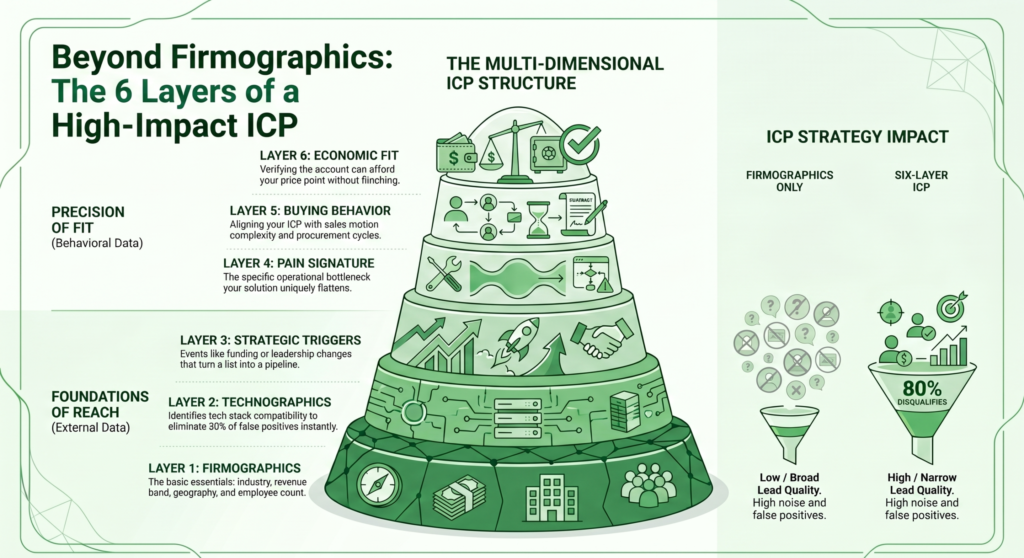
Most ICPs fail because they stop at firmographics. A modern profile needs six layers:
Industry, sub-vertical, revenue band, employee count, geography, public versus private. Necessary but never sufficient.
What is in their stack? If you sell a Salesforce add-on, a HubSpot-native shop is a no. This layer eliminates 30 percent of your false positives instantly. (Our guide on data appending strategies for 2026 walks through the full enrichment ladder.)
What just happened inside the account that makes now the right time? New funding, leadership changes, competitor switches, and hiring sprees in a specific function. Triggers turn a list into a pipeline.
The specific business problem your solution flattens. Not “they want to grow revenue.” That is everyone. It should be “they are losing 40 hours a week to manual contact hygiene across three sales tools.”
Sounds like your team is the one losing 40 hours a week to dirty data?
95.3% email accuracy, quarterly verification, and zero manual spreadsheet cleanup. See how a clean database transforms your ICP execution.
Average deal cycle, committee size, and procurement complexity. A 12-month enterprise sale and a 14-day PLG motion need entirely different ICPs.
Can they actually pay your price without flinching? An ICP that cannot afford you is fan fiction.
Stack these six layers, and you get a profile sharp enough to disqualify 80 percent of your inbound while still hitting your number.
Want to see what your ICP looks like when you actually layer in verified firmographic, technographic, and intent data?
Explore Span Global Services’ customer profiling solution and stop guessing who your best accounts are.
This trips up half the marketers I talk to:
Build ICP first, then build personas inside it. A typical B2B motion has one ICP and three to five personas (champion, economic buyer, technical evaluator, end user, sometimes a legal blocker). Skip the ICP step, and your personas float in a vacuum.
For the long-form walkthrough with templates and interview scripts, see our companion guide on how to create an Ideal Customer Profile. Compressed version:
1. Pull your top 10 to 20 customers by lifetime value and retention. Not your loudest, not your newest. The ones who pay you well and stay.
2. Find the commonalities across the six layers above. What do they share that random accounts do not?
3. Pressure test against your worst churns. What did the bad fits have in common? That becomes your anti-ICP, just as important as the positive profile.
4. Translate into filters your team can actually operationalize. If your SDRs cannot pull a list from this ICP in 30 minutes, it is too abstract.
5. Re-score every 90 days. Markets shift. Your product evolves. A static ICP is a decaying asset, much like the contact data inside it.
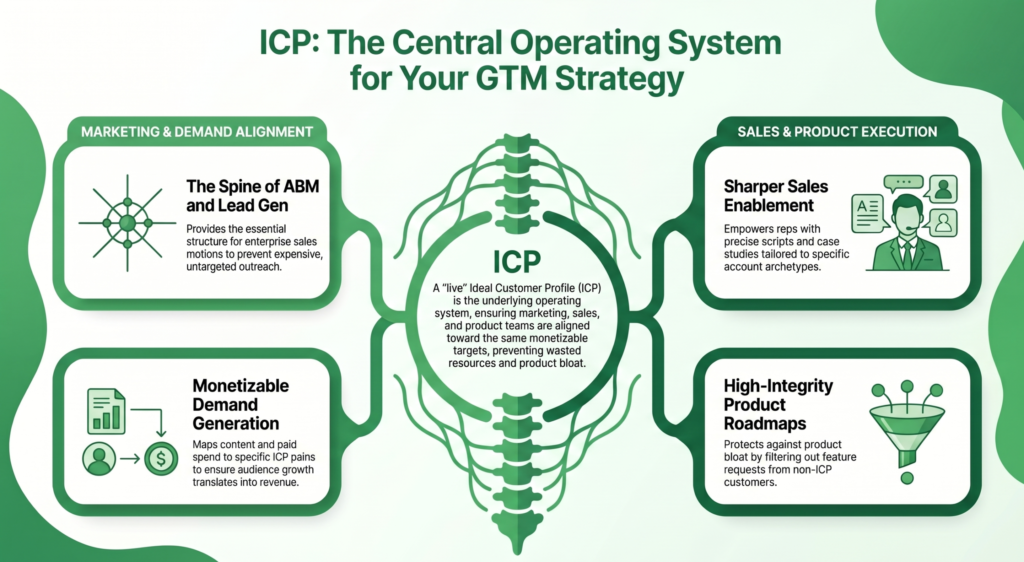
A live ICP is the operating system underneath:
What is ICP in business? It is the most underrated revenue lever your team is probably mishandling. Done well, it compounds: better leads, shorter cycles, higher retention, lower CAC, sharper product. Done poorly, it becomes a deck slide nobody opens.
Building a real ICP is not a six-month consulting engagement. It is a two-week sprint backed by clean data and a willingness to say no to revenue that does not fit.
ICP stands for Ideal Customer Profile. It is an account-level description of the type of company most likely to buy your product, stay long-term, and deliver the highest lifetime value.
No. ICP describes the company. Buyer persona describes the individual humans inside that company who influence the purchase. You need both, in that order.
Usually, one primary ICP per product line. Multiple ICPs splinter focus and dilute messaging. If you genuinely serve two distinct segments, treat them as separate go-to-market motions, not one blended profile.
Every 90 days at a minimum. Markets shift, your product evolves, and your closed-won data tells a sharper story over time. A static ICP decays the same way contact data does.
Yes, more than enterprises. With a limited budget and runway, narrowing focus is survival, not strategy. Early-stage companies with a tight ICP hit product-market fit faster than those chasing every lead.
Ready to operationalize your ICP? Span Global Services helps B2B teams move from fuzzy profiles to filterable, intent-scored target account lists across verified firmographic, technographic, and behavioral data.