

Your sales team just spent three weeks building a targeted prospect list of ecommerce companies. They pulled firmographics: industry, revenue, employee count. They filtered by geography. They wrote personalized openers about the prospect’s product line.
The result? Only a 0.9% reply rate. Because 60% of those companies were already locked into multi-year contracts with your competitor. And your team had no way of knowing.
This is what happens when you prospect on firmographics alone. You know what a company looks like from the outside. You have no idea what it runs on the inside.
Key Takeaway: The 5.6 million businesses on Shopify do not just represent a market segment. They represent a technographic goldmine. Every app they install, every integration they activate, every platform they connect tells you exactly what they need, what they are missing, and when they are ready to buy. The B2B teams that decode this tech stack data will out-target everyone still relying on company size and industry codes.
In this playbook:
Shopify is not just an ecommerce platform. It is the operating system for a massive chunk of global commerce.
As of 2025, Shopify powers over 5.6 million active online stores across 175+ countries. These merchants collectively processed more than $300 billion in gross merchandise volume last year and served over 875 million unique shoppers. In the United States alone, Shopify handles roughly 30% of all ecommerce platform market share.
But the number that matters most for B2B targeting is not stores or GMV. It is the app ecosystem. The Shopify App Store hosts over 11,900 apps across categories like marketing automation, subscription management, analytics, shipping, customer support, and loyalty programs. Approximately 87% of Shopify merchants use third-party apps to run their operations, and the average merchant installs six apps.
That means millions of ecommerce companies are publicly broadcasting their technology decisions every single day. When a Shopify merchant installs Klaviyo, that tells you they prioritize email and SMS marketing. When they add Recharge, they are running a subscription model. When they integrate Gorgias, they are scaling their customer support operation. Each app installation is a technographic data point that, when captured and enriched, creates a prospect profile far more actionable than any firmographic database can deliver.
This is the intelligence layer that most B2B sales teams are missing entirely. They know a company sells fashion online. They do not know that the company runs Klaviyo for email, Rebuy for product recommendations, AfterShip for order tracking, and Shop Pay for checkout optimization. That stack tells you more about the company’s growth stage, budget, and pain points than any annual report ever could.
For teams ready to act on this opportunity, access to a verified Shopify users email list is the fastest path from technographic insight to qualified outreach. For a deeper understanding of how technographic data powers smarter B2B prospecting, explore our guide to leading technology data providers.
Every Shopify merchant’s tech stack is organized around the same five layers. Each layer tells you something different about the business, and more importantly, about what they will buy next.
The first signal is Shopify itself. A company running standard Shopify is likely a small to mid-market business. A company on Shopify Plus is doing between $1 million and $500 million in annual revenue, with Shopify Plus merchants reporting an average 126% year-over-year revenue growth. There are over 47,000 Shopify Plus stores, and these merchants are 5.75 times more likely to run sophisticated app stacks than standard Shopify merchants.
If you sell to mid-market or enterprise ecommerce companies, Shopify Plus merchants are your tier-one ICP. Their platform choice alone tells you they have budget, growth velocity, and operational complexity.
This layer is the richest vein of buying intent in the entire stack. Klaviyo dominates the Shopify email marketing space, with over 117,000 brands using the platform. Merchants running Klaviyo are investing in lifecycle marketing, behavioral segmentation, and SMS automation. They care about customer retention, which means they care about data quality.
Here is what specific marketing tools reveal:
Recharge is the largest subscription platform on Shopify, powering over 20,000 brands and more than $20 billion in processed subscription revenue. Merchants using Recharge have committed to recurring revenue models, which means they have predictable cash flow and higher lifetime value per customer.
Stores running subscription apps also run notably more sophisticated overall stacks. Research shows that subscription merchants install 112% more apps than non-subscription stores, carry 27% fewer products (indicating focused, replenishment-oriented catalogs), and score 30% higher on lead quality benchmarks. These merchants are not hobbyists. They are operators.
Tools like Gorgias (customer support), AfterShip (shipping tracking), and ShipBob (third-party logistics) reveal operational maturity. A merchant running all three is managing volume, investing in customer experience, and likely evaluating new vendors on a regular cycle.
Merchants investing in analytics tools like Google Analytics 4, Triple Whale, or Shopify’s native analytics are data-driven. They measure everything. When you reach out to these companies, you do not sell them data. You sell them precision. They already believe in data. They just need better data.
The Numbers: 87% of Shopify merchants use third-party apps. The average merchant installs six apps, with sophisticated subscription brands running more than double that number. Each app is a technographic signal that reveals budget, growth stage, and buying intent. (Source: Uptek, StoreInspect)
Knowing what apps a company uses is interesting. Turning that knowledge into qualified pipeline is what matters. Here is a four-step method for B2B teams selling data, marketing services, or technology to the Shopify ecosystem.
Stop filtering prospects by revenue and headcount alone. Start filtering by technology profile.
If you sell email enrichment or data verification services, your best prospects are not “ecommerce companies with 50+ employees.” Your best prospects are Shopify Plus merchants running Klaviyo with more than 10,000 email subscribers and a 90-day email campaign history. Those companies have a data problem they know about. They have bounce rates creeping up, segmentation losing accuracy, and flows underperforming because 3% of their list decayed last month.
This is the difference between spray-and-pray outreach and precision targeting. One approach fills your CRM with names. The other fills your pipeline with qualified opportunities.
Every technology combination implies a specific operational pain:
| Stack Signal | What It Means | What They Need |
| Klaviyo + Recharge + no data enrichment tool | Running lifecycle campaigns on decaying subscriber data | Email verification, appending, enrichment |
| Shopify Plus + Gorgias + high volume | Scaling support without scaling headcount | Better customer segmentation data to reduce ticket volume |
| Multiple ad pixels + Triple Whale | Heavy paid acquisition, tracking attribution | Audience expansion with net-new, verified contacts |
| Subscription app + high churn | Losing subscribers faster than acquiring them | Retention intelligence, win-back data, predictive signals |
Generic messaging like “We help ecommerce companies grow” gets deleted. Stack-specific messaging gets read.
Compare these two approaches:
Generic: “Hi, I’d love to show you how our data solutions can help your business.”
Stack-specific: “I noticed your store runs Klaviyo for lifecycle marketing and Recharge for subscriptions. Most brands at your scale see email deliverability drop 2 to 3% per quarter as subscriber data ages. We help Shopify Plus brands keep their Klaviyo lists at 97%+ deliverability through verified, real-time data enrichment. Worth a 10-minute call?”
The second version proves you understand the prospect’s world. It references tools they actually use. It quantifies a problem they actually have. That is the difference between a cold email and a warm signal.
Technographic data tells you who to target. Intent data tells you when. The combination is where pipeline generation becomes predictable.
A Shopify Plus merchant running Klaviyo who is currently researching “email deliverability solutions” or “B2B data enrichment” is not a cold prospect. They are an in-market buyer. Your job is to show up with the right message at the right moment. That requires both technographic intelligence and real-time intent signals working together.
The Method: Define ICP by stack profile. Map stacks to pain points. Write stack-specific outreach. Layer intent data for timing. This is the Technographic Targeting Method, and it turns publicly available tech stack data into a repeatable pipeline engine.
The most valuable technographic insight is not what a company uses. It is what they are missing. Gaps in a tech stack are buying signals hiding in plain sight.
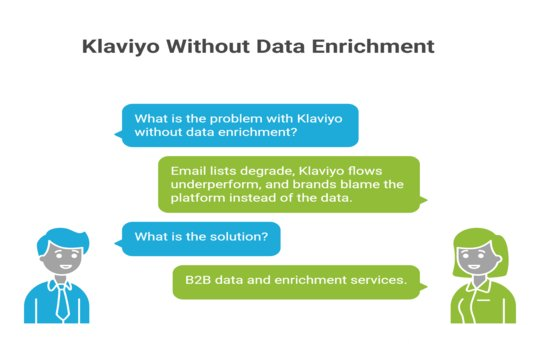
Over 117,000 Shopify brands run Klaviyo. The vast majority have no data enrichment or verification tool in their stack. That means their email lists are degrading at roughly 2 to 3% per month, their Klaviyo flows are underperforming, and they are blaming the platform instead of the data. This is a massive, addressable market for B2B data and enrichment services.
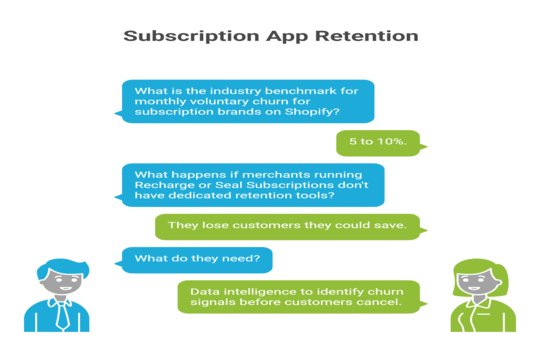
Subscription brands on Shopify experience 5 to 10% monthly voluntary churn as an industry benchmark. Merchants running Recharge or Seal Subscriptions without dedicated retention tools (loyalty programs, win-back flows, predictive analytics) are losing customers they could save. They need data intelligence to identify churn signals before customers cancel.
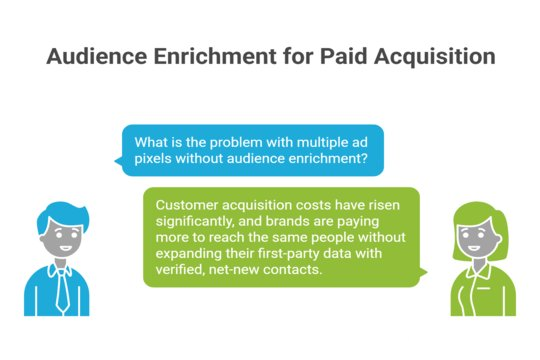
Stores running Facebook Pixel, Google Ads conversion tracking, TikTok Pixel, and Pinterest Tag are investing heavily in paid acquisition. But customer acquisition costs for DTC brands have risen 40 to 60% since 2023. Without audience enrichment (expanding their first-party data with verified, net-new contacts), these brands are paying more every quarter to reach the same people.
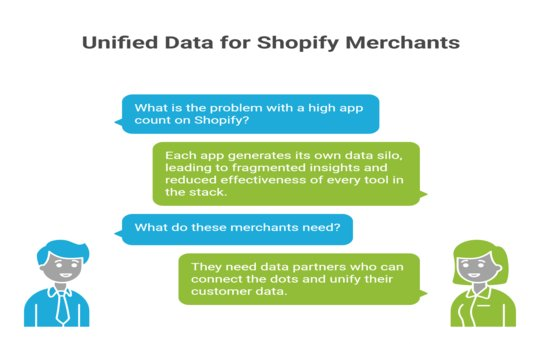
The average Shopify merchant installs six apps. Sophisticated brands install 12 or more. Each app generates its own data silo. Without a unified customer data strategy, these merchants are sitting on fragmented insights that reduce the effectiveness of every tool in their stack. They need data partners who can connect the dots.
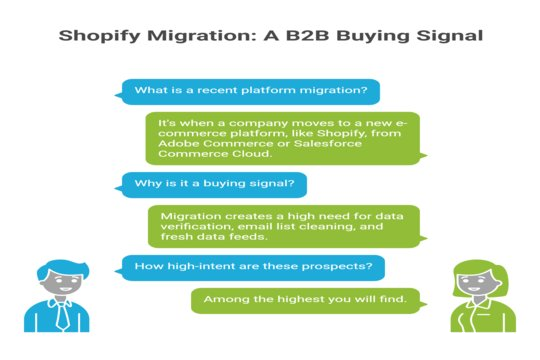
Over 42% of new enterprise ecommerce launches in the past two years chose Shopify, with many migrating from Adobe Commerce or Salesforce Commerce Cloud. Migration creates a window of maximum data need: customer records need re-verification, email lists need cleaning, and integrations need fresh data feeds. Recent platform migrators are among the highest-intent B2B prospects you will find. For a closer look at the scale of this ecosystem, explore our breakdown of the top companies that use Shopify.
Here is the uncomfortable truth about technographic intelligence: it is only useful if the underlying contact data is accurate.
You can identify that a Shopify Plus merchant runs Klaviyo, Recharge, and Gorgias. You can map their exact pain points. You can write the perfect stack-specific cold email. And then it bounces. Because the VP of Marketing you targeted left the company four months ago. Because B2B contact data decays at roughly 3% per month, and the database you bought was last verified two quarters ago.
Technographic targeting without accurate contact data is a strategy without execution. You have the map, but you cannot reach the destination.
This is why the combination of technographic intelligence and continuously verified contact data is the real competitive moat. You need to know what a company runs (their stack), who makes the buying decision (the verified contact), and when they are ready to evaluate (intent signals). All three layers must be accurate and current.
The global B2B ecommerce market is projected to reach $36 trillion by 2026, growing at a 14.5% CAGR. There are 5.6 million Shopify stores, 47,000+ Shopify Plus merchants, and an 11,900-app ecosystem broadcasting buying signals every single day. The opportunity is staggering. But only if your data can reach the people who matter.
The 1.8 million companies on Shopify are not a monolithic list to be emailed in bulk. They are a technographic ecosystem that reveals exactly what each business runs, what they are missing, and where they are heading.
B2B teams that continue to prospect based on industry codes and company size will keep seeing sub-1% reply rates. Teams that adopt technographic targeting, mapping prospect tech stacks to pain points and layering intent data for timing, will build a predictable pipeline in one of the fastest-growing market segments on the planet.
The infrastructure you need is not complicated. It is accurate. You need verified contacts at the companies that match your technographic ICP. You need those contacts enriched with firmographic, technographic, and intent signals. And you need that data refreshed continuously, because in an ecosystem where merchants add and remove apps weekly, stale data is dead data.
That is precisely what Span Global Services delivers. With 296 million B2B contacts verified across 78 data fields, covering 189+ countries and 15+ global compliance standards, SGS provides the enriched, intent-aware intelligence layer that turns technographic insights into closed revenue.
Request a free data sample and start targeting e-commerce decision-makers with the precision their tech stack demands.
Technographic data reveals what software, platforms, and technology infrastructure a company uses. For B2B targeting, this data is critical because it shows technology gaps, replacement opportunities, and buying signals. For example, knowing a company uses Shopify Plus with Klaviyo but lacks a data enrichment tool tells you exactly what they need before you ever make contact. Companies using technographic targeting report 3 to 5x improvements in connect rates compared to firmographic-only prospecting.
Over 5.6 million active stores operate on Shopify globally, with more than 47,000 on the enterprise-tier Shopify Plus. The average merchant installs six apps across marketing, subscriptions, shipping, analytics, and customer support. Popular apps include Klaviyo (117,000+ brands), Recharge (20,000+ brands), Gorgias, AfterShip, and Rebuy. Each installation is a technographic signal that B2B teams can use for precision targeting.
B2B teams can define their ICP by technology profile instead of company size alone. By identifying which apps a Shopify merchant runs, teams can map specific pain points (like email deliverability issues for Klaviyo users without data enrichment) and write stack-specific outreach that demonstrates deep understanding of the prospect’s operations. Layering intent data on top of technographic intelligence adds timing precision to the targeting.
Technographic targeting identifies the right companies and the right pain points, but it only works if the contact data reaching decision-makers is accurate. B2B contact data decays at approximately 2 to 3% per month. A perfectly targeted message that bounces or reaches someone who has changed roles delivers zero pipeline value. Continuous data verification and enrichment are essential to convert technographic insights into actual revenue.
Five key patterns predict purchase intent: merchants running Klaviyo without data enrichment (decaying email lists), subscription apps without retention tools (high churn), multiple ad pixels without audience enrichment (rising CAC), high app counts without unified data (fragmented insights), and recent platform migrations from legacy systems to Shopify (maximum data need during transition). Each of these gaps represents a specific, addressable problem that B2B data and marketing service providers can solve.