
Demand Gen vs Lead Gen
Sooner or later, every B2B marketing leader gets the question from a CFO or a CRO: “Are we doing demand generation or lead generation?”
It is a fair question. The two terms are used interchangeably in job titles, agency pitches, and software categories, even though they describe genuinely different motions. Worse, the answer most marketers give is incomplete. They explain demand gen as “top of funnel” and lead gen as “form fills,” and the conversation ends with the executive nodding politely and quietly assuming both teams are doing the same thing twice.
In 2026, that confusion is expensive. B2B buying committees have grown to an average of 11 people. Sales cycles are longer. Budgets are tighter. And the teams that cannot articulate where demand generation ends, and lead generation begins, are the teams losing pipeline to competitors who can.
This guide explains the difference and clears the confusion. By the end of this article, you will know exactly what demand generation is, how it differs from lead generation, and how the two work together inside a single revenue engine.
Already running demand gen but your pipeline isn’t matching audience growth? Skip the theory
and talk to a strategist.
Demand generation is the set of marketing activities that create awareness, educate the market, and build interest in your category before a buyer is ready to purchase.
It is not a single tactic. It is a discipline that spans content marketing, organic social, paid distribution, podcasts, webinars, community building, PR, SEO, partnerships, and brand-building activity. The goal is not to capture a contact today. The goal is to make sure that when a prospect eventually enters a buying cycle, your brand is the one they already trust.
If the output of an activity is a person who knows your category exists, understands the problem you solve, and trusts your point of view, that activity is demand generation.
If the output is a name, email, and phone number sitting in your CRM ready for an SDR to call, that activity is lead generation.
|
⏳ Long Game
Demand Generation
Builds awareness, trust, and category authority over months and quarters.
|
⚡ Short Game
Lead Generation
Captures contacts ready to talk to sales right now, this week, this quarter.
|
Both are necessary. Neither is sufficient on its own.
Demand generation creates the market conditions in which lead generation can actually work. Skip it, and your SDRs end up cold-calling prospects who have never heard of you.
Lead generation is the set of activities that capture identifiable contact information from prospects who have shown enough interest to engage.
Form fills, gated content downloads, demo requests, webinar registrations, contact list rentals, and outbound prospecting motions all fall under lead generation. The defining feature is conversion: a prospect moves from anonymous to identified, with verifiable contact details that sales teams can act on.
|
Form Fills
|
Gated Downloads
|
Demo Requests
|
|
Webinar Registrations
|
Contact List Rentals
|
Outbound Prospecting
|
Lead generation is measurable in a way that demand generation often is not. You can count leads. You can track cost per lead. You can score, route, and follow them through the funnel. This measurability is part of why CFOs love lead generation budgets and approach demand generation budgets with skepticism.
Lead gen produces numbers on a dashboard. Demand gen produces the conditions that make those numbers possible.
For a deeper view of how lead generation operates at scale, our B2B lead generation service overview breaks down the data infrastructure and outreach motion modern teams need to run.
Here is the honest version, stripped of agency jargon.
| Dimension | Demand Generation | Lead Generation |
|---|---|---|
| Goal | Create awareness and interest in the category | Capture identified contacts ready for sales follow-up |
| Audience | Broad market, often not in-buying-cycle | Narrower, showing active interest |
| Time Horizon | Long. Months to quarters before payoff | Short. Days to weeks |
| Output | Trust, recognition, category authority | Names, emails, and phone numbers in the CRM |
| Primary Metric | Reach, engagement, share of voice | Marketing-qualified leads, cost per lead, conversion rate |
| Asset Examples | Podcasts, thought leadership, organic social, SEO content | Whitepapers, demo requests, gated reports, paid lists |
| Reports To | CMO, brand, growth | Demand gen director, RevOps, sales |
| Failure Mode | “We have a lot of followers but no pipeline.” | “We have a lot of leads, but they don’t convert.” |
The mistake most beginner teams make is treating these as competing philosophies. They are not. They are sequential stages of the same engine.
Demand generation creates the conditions. Lead generation converts the demand into named, contactable, sales-actionable opportunities. A team that only runs demand generation builds an audience that never buys. A team that only runs lead generation runs out of people to cold email by Q3.
Demand gen vs lead gen is a false debate. The real question is whether your two motions are sequenced and integrated, or running in isolation.
Beginner teams often ask what demand generation actually looks like in practice. Strip away the buzzwords, and modern B2B demand generation comes down to five core activities.
|
1
|
Category Education ContentLong-form articles, podcasts, video, and thought leadership that teach your market a new way to think about a problem. This is the highest-leverage activity in demand generation because it positions your brand as the authority before competitors get to the conversation. |
|
2
|
Organic Social and Community BuildingLinkedIn presence, founder-led content, niche community engagement, and category newsletters. These channels build the personal trust that makes outbound work three months later. |
|
3
|
Paid Distribution of Owned MediaLinkedIn ads, podcast sponsorships, newsletter placements, and YouTube pre-roll that amplify your best content to the exact audience you want to reach. This is paid demand gen, not paid lead gen. The goal is ‘reach’, not form fills. |
|
4
|
SEO and Search AuthorityBuilding a programmatic SEO footprint that captures buyers at the moment they search for category education. A beginner’s guide blog like this one is a demand generation asset because it builds awareness without asking for an email. |
|
5
|
Partnerships, Events, and Co-MarketingWebinars with adjacent vendors, conference sponsorships, integration launches, and joint content. These multiply reach by borrowing trust from partner audiences. |
A working demand generation engine runs all five of these activities consistently. Our demand generation strategy playbook walks through how to sequence them for a new brand and how to scale them as your category matures.
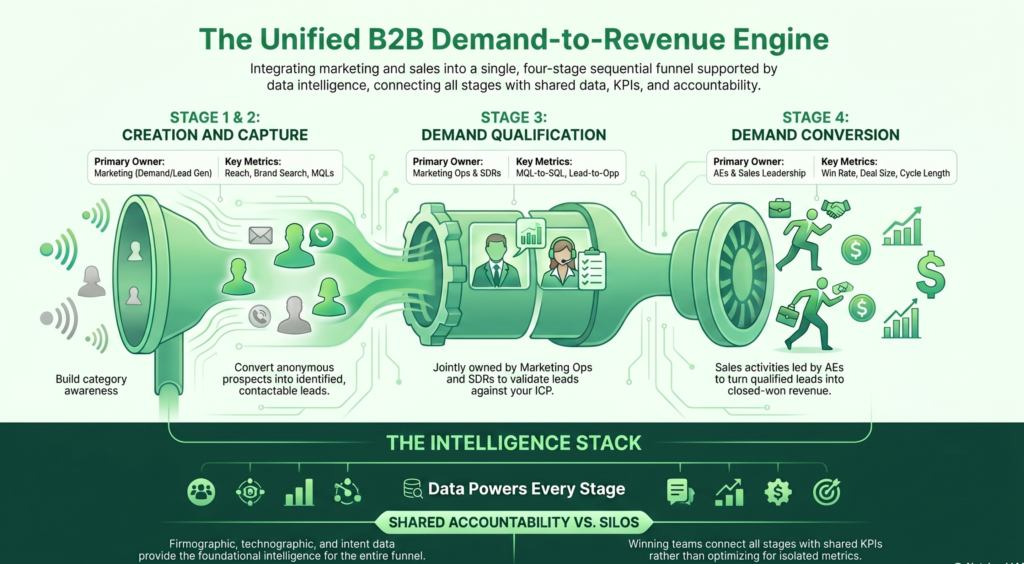
Here is the framework every B2B marketing team should anchor on. We call it the Demand-to-Revenue Funnel. It collapses the false debate between demand gen and lead gen into a single, sequential engine.
|
STAGE
01
|
Demand CreationActivities that build category awareness and brand trust. Owned by
Demand gen Measured by
Reach, engagement, brand search volume, direct traffic |
|
STAGE
02
|
Demand CaptureActivities that convert aware-but-anonymous prospects into identified, contactable leads. Owned by
Lead gen Measured by
MQLs, conversion rate, cost per lead |
|
STAGE
03
|
Demand QualificationActivities that score, route, and validate leads against your ICP. Owned by
Marketing ops + SDR teams (joint) Measured by
MQL-to-SQL conversion, lead-to-opportunity rate |
|
STAGE
04
|
Demand ConversionSales activities that turn qualified leads into closed-won revenue. Owned by
AEs and sales leadership Measured by
Win rate, deal size, sales cycle length |
The teams winning in 2026 have all four stages connected with shared data, shared KPIs, and shared accountability. The teams losing have demand gen optimizing for impressions, while lead gen optimizes for form fills, and sales optimizes for closed-won, with nobody owning the handoffs.
Layered underneath all four stages is the intelligence stack: firmographic, technographic, and intent data. These are not stage-specific. They power every stage.
For more on how intent signals plug into the demand-to-revenue motion, see our guide to using intent data for B2B sales success.
If you are building a demand generation function from scratch or repairing one that has stalled, here is a sequence that works.
Step 1: Audit what you already have. Most teams have more demand generation assets than they realize. Old blog posts, founder LinkedIn content, conference talks, podcast appearances. Inventory them before creating anything new.
Step 2: Define your category narrative. What is the one story you want the market to associate with your brand? Demand generation without a category narrative is content marketing without a point of view, which is to say, ignorable.
Step 3: Pick two channels and commit for six months. Beginner teams over-commit to channel breadth and under-commit to channel depth. Two channels run consistently for six months will outperform six channels run inconsistently for two.
Step 4: Integrate with lead generation handoffs. Decide what triggers a demand gen asset to become a lead gen capture moment. Is it a second blog visit? A pricing page view? A specific content download? Define the trigger and the handoff.
Step 5: Measure leading indicators, not just lagging ones. Pipeline contribution from demand gen is a six-month lagging metric. Brand search growth, direct traffic, content engagement, and audience growth are leading indicators that tell you whether the engine is working before the pipeline shows it.
A useful companion read on the email side of this motion is our breakdown of email marketing tactics that drive demand generation.
A few patterns we see repeatedly with teams new to demand generation:
Treating demand gen as just more lead gen. Adding “ungated” to the front of every gated asset and calling it demand generation. The change is cosmetic. Real demand generation rebuilds the content and the channel strategy around audience value first, capture second.
Measuring demand gen with lead gen metrics. Cost per lead is a useless metric for a podcast. Reach is a useless metric for a demo request. Match the metric to the stage.
Skipping the category narrative. Without a clear point of view, your demand gen content is interchangeable with every other vendor’s. Category narratives are how brands become memorable.
Underfunding demand gen because it doesn’t show up in pipeline reports. Demand gen ROI shows up as branded search volume, faster sales cycles, higher win rates, and shorter outbound ramp times. Build a measurement framework that captures these before the CFO defunds your podcast.
For a sharper view of why traditional lead-only motions are losing efficiency in 2026, our piece on intent data vs traditional lead generation covers the conversion math.
Three forces are reshaping demand gen this year.
|
✦
Force 01
|
AI Is Collapsing the Cost of ProductionAI is collapsing the cost of producing demand gen assets. Video, podcasts, design, and writing can all be produced faster than ever. The bottleneck is no longer production. It is a point of view. Brands with a defensible category narrative will widen their lead. Brands without one will produce more content that says nothing. |
|
◐
Force 02
|
Buyers Are Moving Into Dark SocialBuyers are spending more time in dark social. WhatsApp groups, Slack communities, Discord servers, and private LinkedIn DMs are where category conversations actually happen.
Demand gen teams that can earn presence in those spaces will outperform teams still optimizing for public feed engagement. |
|
⇄
Force 03
|
Demand Gen and Lead Gen Are MergingThe demand gen and lead gen functions are merging operationally. The teams running ahead are organizing around the Demand-to-Revenue Funnel, not around legacy team boundaries. Expect titles, budgets, and tooling to follow. |
|
→
|
Step 1 · Strategy
Talk to a Demand Generation StrategistIf you are building or rebuilding your demand engine and want a conversation about where to start, explore our demand generation services for a no-pressure consultation. |
|
↗
|
Step 2 · Capture
Scale Your Lead CaptureWhen demand generation creates the audience, lead generation captures the opportunity. See how our lead generation services help B2B teams convert awareness into named pipeline. |
|
✦
|
Step 3 · Learn
Keep LearningOur blog publishes weekly on demand generation, lead generation, intent data, ABM, and the workflows that turn awareness into revenue. |