
B2B intent data is the digital footprint companies leave behind when they research a problem or evaluate a solution. In 2026, it became the third layer of B2B intelligence, sitting alongside firmographic and technographic data. This article explains what intent data is, where the signals come from, the three types you need to know, and how beginner teams can put it to work without overspending on enterprise platforms.
Picture a familiar scene. Your SDR sends 500 cold emails on Monday morning. By Friday, 12 have replied, 3 have booked meetings, and 2 will eventually become opportunities. The other 488 prospects? Many of them were not in-market for what you sell. Some had just renewed a competing contract. Some had no budget. A few were actually evaluating solutions exactly like yours, but you had no way of knowing.
This is the gap B2B intent data closes. Instead of treating every prospect in your total addressable market as equally likely to buy, intent data helps you identify the small, time-sensitive subset of accounts that are actively researching solutions right now.
For beginner teams, the value proposition is simple. Intent data turns outbound from a volume game into a precision game. And in 2026, with buying committees larger, sales cycles longer, and budgets tighter, precision is what separates the teams hitting quota from the teams missing it.
B2B intent data is behavioral information that signals when a company is researching, evaluating, or preparing to purchase a specific product or service.
Think of it as digital body language at the company level. When employees at a target account start reading articles about workflow automation, downloading vendor comparison guides, attending category webinars, or visiting review sites like G2 and Gartner Peer Insights, those actions leave traces.
Aggregated and analyzed, those traces tell you something powerful: this company is likely in-market.
A useful way to frame it for a beginner team:
Firmographics tell you who the company is.
Technographics tell you what the company runs.
Intent data tells you what the company is thinking about right now.
All three matter and work best together.
Key takeaway: Intent data does not replace your existing prospect list. It helps identify which accounts are worth prioritizing right now.
Not all intent signals are created equal. Beginners should understand the three categories because the source determines both the cost and the use case.
Quick view: First-party tells you what known prospects do on your properties, second-party extends that signal through partners, and third-party helps uncover wider in-market demand.
Beginner Maturity Path
Most mature B2B teams use all three. Beginner teams should start with first-party, layer in second-party as ABM matures, and add third-party when scaling outbound.
Want the data behind the stack?
SGS provides verified B2B contact data, technographic intelligence on 25M+ businesses, and intent-ready prospect lists built for teams at every stage.
The phrase “buying signal” gets thrown around loosely, so it helps to be specific. Intent signals fall into roughly five categories:
Content consumption signals. A target account reading multiple articles on a specific topic over a short period. Three engineers downloading the same whitepaper. A surge in pageviews on a vendor comparison post.
Search and research signals. Companies appearing in third-party data when researching specific keywords or topics. Visits to review sites and analyst platforms.
Engagement signals. Webinar attendance, demo requests, product trial signups, sales meeting acceptances, and email replies after months of silence.
Hiring and operational signals. A company posting jobs for roles that imply they need your category of solution. A logistics platform posting Director of Supply Chain Optimization roles is signaling priorities.
Trigger event signals. Funding rounds, leadership changes, M&A activity, regulatory shifts, and technology adoption announcements. These create budget and urgency where neither existed before.
A beginner-friendly rule: a single signal is noise. A pattern of signals over a short window is intent.
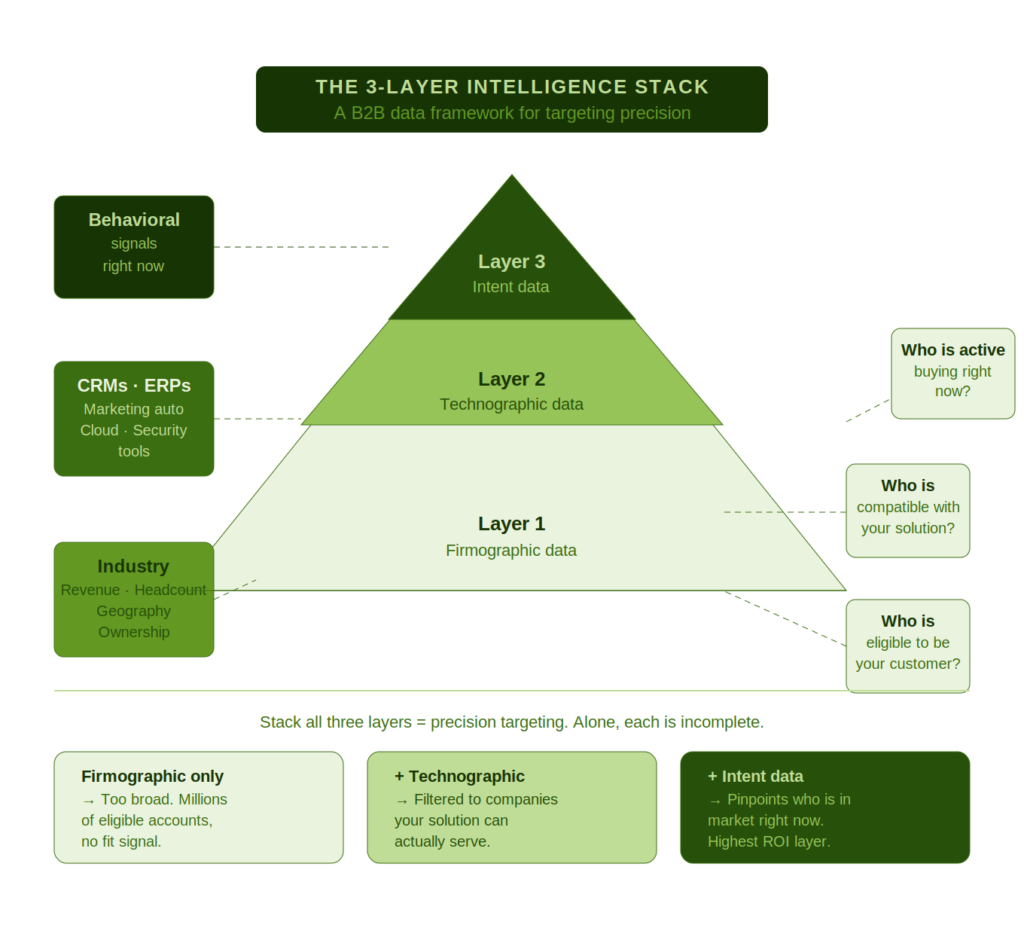
Here is the framework that should anchor how any beginner team thinks about intent data. We call it the 3-Layer Intelligence Stack.
Layer 1: Firmographic data. Industry, revenue band, employee count, geography, and ownership structure. This defines who is eligible to be your customer.
Layer 2: Technographic data. The technology stack running inside the company. CRMs, ERPs, marketing automation, cloud infrastructure, and security tools. This defines who is compatible with your solution and where the integration or displacement opportunities sit.
Layer 3: Intent data. The behavioral signal layer that tells you who is active in the buying cycle right now.
Firmographic and technographic data answer “who should we sell to?” Intent data answers “who should we sell to this week?” You need all three. A list of in-market accounts that don’t fit your ICP is wasted spend. A list of perfect-fit accounts with no current buying intent is a six-month nurture cycle.
The teams getting outsized returns from intent data in 2026 are the ones using it as the third layer of an already-strong intelligence foundation, not as a magic bullet bolted onto a weak prospect list.
Key takeaway: Intent data is a multiplier, not a starting point. It works best when layered on top of solid firmographic and technographic targeting.
Theory is easy. Application is where most teams stall. Here is a practical sequence for any team starting.
Step 1: Get your first-party signal collection right. Before paying for any external intent data, make sure you are capturing and using the intent signals already coming through your own website, content, and email. Most B2B teams are sitting on first-party intent gold they have never operationalized.
Step 2: Define your intent topics. What topics, problems, or solution categories should trigger a sales action when a target account starts researching them? Be specific. “Cloud security” is too broad. “Zero trust network access” is actionable. List 10 to 15 topics tied directly to your product.
Step 3: Build a tiered response playbook. Not every signal deserves a sales outreach. A single content download might trigger a marketing nurture. Multiple downloads plus a pricing page visit might trigger an SDR call. Define the thresholds, so your team knows what to do when signals fire.
Step 4: Layer in second or third-party data once the first-party is working. Adding paid intent data on top of a broken process amplifies the chaos. Get the foundation right, then scale.
Step 5: Measure conversion, not just volume. The right metric for intent data is conversion rate from intent-flagged account to opportunity. If that number is not materially higher than your baseline, your intent data is either inaccurate, mismatched to your ICP, or being acted on too slowly.
For deeper tactical guidance on Steps 2 through 5, our guide to using intent data for B2B sales success walks through specific play examples and conversion benchmarks.
A few patterns we see repeatedly with teams new to intent data:
Three trends are reshaping the space, and beginners should know what they are walking into.
First, AI is making intent signals smarter. Machine learning models now score signal patterns with much higher accuracy than rule-based systems could a few years ago. Our look at how AI is transforming intent data collection covers the operational implications.
Second, the provider landscape is consolidating but specializing. Some platforms are absorbing intent into broader ABM suites. Others are doubling down on niche industry depth. A side-by-side view of the top platforms is in our comparison of leading B2B intent data providers.
Third, the intelligence stack is becoming the table-stakes foundation for revenue teams. The competitive gap between teams running a unified firmographic + technographic + intent stack and teams operating without one is widening every quarter.
For teams ready to go beyond the basics, our revenue-driven marketer’s guide to B2B intent data is the natural next read.
One conversation could save you months of guesswork.
Talk to a Span Global Services data strategist. We will help you figure out where to start, what data layers you need, and how to activate them without overspending.
Intent data only works when it sits on top of clean, accurate firmographic and technographic foundations. That is what Span Global Services has spent two decades building: continuously verified B2B contact data, technographic insight on what your prospects actually run, and intent signals that show you who to engage right now.
📊 Explore technographic data
Layer 2 of the intelligence stack. We map the tech install base for over 25 million businesses worldwide.
📚 Keep learning
Weekly posts on intent data, ABM, technographic strategy, and workflows that turn data into revenue.