Here is a list most B2B marketers are reading wrong.
When you see that Latham & Watkins deployed Harvey firmwide, or that HSBC rolled legal AI across its in-house function, the instinct is to file it under “legal industry news.” That is the mistake. Every name on the list below is not just a LegalTech adoption story. It is a buying signal with a deadline attached.
The logic is simple. When an organization deploys legal AI agents at scale or migrates its legacy legal databases to the cloud, it instantly creates net-new requirements: the AI has to be secured, the data has to be hosted and integrated, and every new workflow has to be proven compliant. Those requirements are budget. That budget belongs to cybersecurity providers, cloud integration specialists, and compliance consultants. And the LegalTech upgrade is the starting gun.
So this is a list of who is upgrading. But read it as a list of who just opened a budget you can sell into. For each name, we flag the adjacent spend the upgrade unlocks.
Key Takeaway
A LegalTech upgrade is rarely a single purchase. It is the trigger for a cluster of adjacent spend on security, cloud, and compliance. The vendors who map that cluster and reach the decision-makers early win the follow-on budget.
These are the AmLaw 100 and Magic Circle firms, thousands of attorneys each, deploying legal AI across the entire organization. Their deployments are slow, high-security, and multi-stakeholder, which is exactly why they create such a long adjacent-selling window.
The headline deployment. Latham signed an enterprise license for a firmwide rollout of the Harvey platform and its full suite of generative AI solutions, making it available across more than 3,600 attorneys globally plus the business professionals who support legal service delivery. Latham also built an internal AI Academy with mandatory, billable-credit training to drive adoption across every practice.
What It Unlocks
A firm wiring AI into 3,600 attorneys’ daily work needs data loss prevention, tenant isolation, and AI governance. That is a security and compliance sale created the day the license was signed.
Harvey’s public deployment roster runs deep into elite global firms, each on a six to nine month, forward-deployed rollout cycle because BigLaw deployment cannot be done as remote self-serve SaaS. Strict confidentiality regimes, on-prem and private-cloud data-residency requirements, and partner-by-partner adoption each individually defeat plug-and-play. Macfarlanes pushed even further, launching a client-facing AI platform called Amplify after hitting an internal Harvey adoption rate above 80%.
What It Unlocks
Confidentiality regimes mean security spend. Data-residency requirements mean cloud and infrastructure spend. A six to nine month deployment window is a six to nine month selling window for everyone in the supporting cast.
The pattern is acceleration, not pilots. DLA Piper International expanded its Harvey work and McCann Fitzgerald went firmwide, both named among Harvey’s recent customer wins in early 2026. When a firm moves from pilot to firmwide, the infrastructure and compliance requirements scale with it.
What It Unlocks
Scaling from a department to an entire firm multiplies the integration, hosting, and audit footprint. That is fresh budget on top of the original deployment.
Key Takeaway
Across the AmLaw 100 and Magic Circle, the question is no longer whether to deploy legal AI, but how to secure, host, and govern it at scale. Every one of those is an adjacent vendor’s opening.
This is the larger, faster-moving half of the list and the one most often overlooked by vendors. These are major corporate legal departments that are already operationalizing AI at scale. Corporate legal teams are no longer just evaluating AI; they are actively integrating it into daily workflows.
In January 2026, HSBC announced a strategic partnership to roll Harvey out across its in-house legal function, part of a wider push to embed AI across the bank. HSBC’s group chief legal officer framed it as reimagining how an in-house legal function operates while supporting enterprise-grade controls and security aligned to regulatory expectations.
What It Unlocks
A global bank deploying legal AI inside a regulated environment needs security controls, audit logging, and compliance validation as a precondition, not an afterthought. That is the cleanest possible compliance and cybersecurity sale.
The general counsel and chief legal officers of these companies sit on Harvey’s inaugural in-house advisory board, a roster that reads like a cross-section of corporate legal power across media, industrials, finance, tech, and advertising. Advisory board membership is a strong signal of deep, strategic deployment, not casual usage.
Harvey has been explicit about targeting enterprise legal teams, and its customer list reflects organizations with heavy regulatory and contractual workloads. Legal AI is increasingly treated as operational infrastructure rather than a niche productivity tool.
What It Unlocks
When legal AI becomes operational infrastructure, it inherits infrastructure-grade requirements: uptime, security, integration, and compliance. Those requirements are bought by IT and security teams, not lawyers.
Key Takeaway
The corporate buyer sits closer to procurement and IT than the law firm partner does, so their LegalTech decision is usually bundled with CRM, ERP, identity, and security tooling. That bundling is your opening.
Not every upgrade makes headlines. The quietest entries on this list are often the richest, because contract platforms and database migrations are where the cloud and integration money actually lives.
CLM is an enterprise infrastructure decision, not light tooling. The integration footprint is the real story: Ironclad spans Salesforce, Slack, DocuSign, Google Workspace, and Microsoft 365, with contracts initiated directly from Salesforce opportunities and pushed back to the CRM.
What It Unlocks
A platform that plugs into five enterprise systems needs someone to wire those integrations, secure the data flowing between them, and keep it compliant. That is a direct integration and security sale.
Before any AI layer works, decades of contracts and matter files have to be pulled out of folders and email threads into a clean, structured cloud repository. Forward-looking legal departments now treat metadata and clause tagging not as administrative overhead but as the training data for their future AI layer. Translation: a wave of legacy migration is underway, much of it unannounced.
What It Unlocks
Cloud storage, data migration services, integration specialists, and the security and compliance layer governing newly centralized, highly sensitive data. A legacy migration is a cloud vendor’s dream account, and a LegalTech upgrade is what kicks it off.
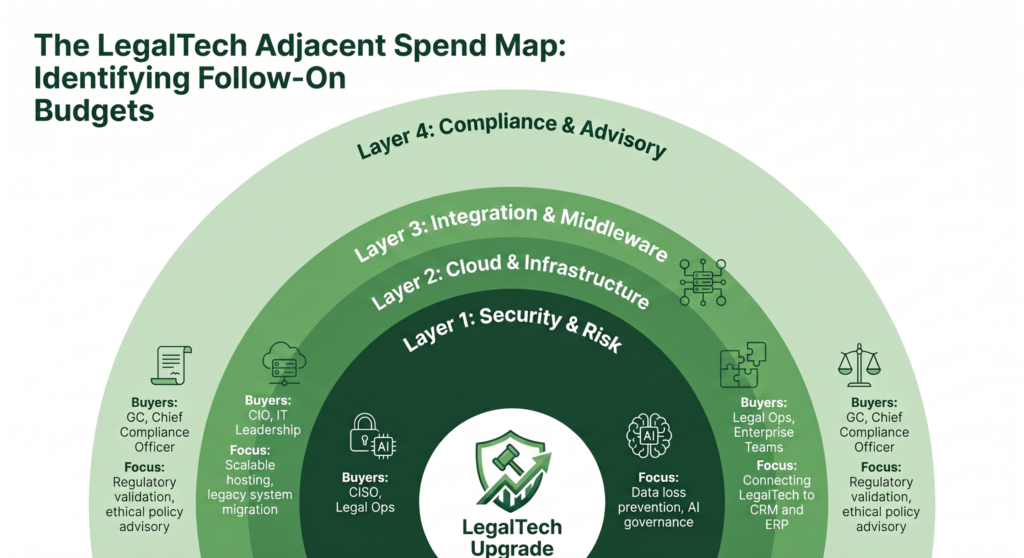
Here is the framework that makes the entire list actionable. Every LegalTech upgrade outlined above radiates outward into four predictable layers of follow-on budget. Identify the layer you sell into, then target the buyers within it.
You don’t have to guess where the budget sits. The layer determines the buyer, and the names on this list show which accounts are already active.
A list of names is worthless if you reach the people behind them after the follow-on budget has already been spent. Timing is the entire game.
The Window Is Open Now
The six to nine month firm deployment window and the three to six month CLM implementation timeline are exactly when adjacent vendors need to be in the conversation. Miss that window, and you are pitching into a closed budget.
To act on this list, you need three things.
General counsel, chief legal officer, head of legal operations, director of legal technology, plus the CISO and CIO who co-own the new risk and infrastructure layers. “Legal contacts” is not enough. You need decision-makers and budget holders mapped to the specific layer you are selling into.
The firms and corporations most likely to be mid-upgrade: Am Law 100 and Magic Circle firms, as well as corporate legal departments at large cybersecurity, financial services, manufacturing, and technology companies.
Stale or inaccurate data turns a strong strategy into bounced emails and dead phone numbers. The window is too short to waste on unreliable records.
This is the gap between reading the list and capitalizing on it. The names are public. The advantage goes to whoever can place the right message in front of the right legal and technology decision-makers while the budget is still open.
LegalTech adoption is one of the cleanest enterprise buying signals available in 2026, and almost nobody outside the legal vendors is treating it as one. Every firm and corporation on this list created immediate, time-boxed demand for cybersecurity, cloud integration, and compliance providers the moment they signed. The vendors who reach those buyers first win the follow-on budget. The rest find out from a press release, six months too late.
You cannot run this play on intuition. You need a current, verified list of corporate legal decision-makers and the technology buyers who sit alongside them, segmented by industry, title, and the adjacent layer you sell into. That is exactly what Span Global Services builds.
Span Global Services maintains B2B contact intelligence on legal, IT, security, and compliance decision-makers across the enterprises and firms most likely to be upgrading right now. We help cybersecurity, cloud, and compliance vendors target the exact buyers whose budgets a LegalTech upgrade just unlocked.
As of early 2026, Harvey’s public deployment roster includes Latham & Watkins (a firmwide rollout across more than 3,600 attorneys), Allen & Overy / A&O Shearman, Cleary Gottlieb, Macfarlanes, Reed Smith, DLA Piper, and McCann Fitzgerald. On the corporate side, HSBC rolled Harvey out across its in-house legal function, and general counsel from NBCUniversal, Koch, Bridgewater Associates, MongoDB, and Dentsu sit on Harvey’s in-house advisory board. Each of these deployments creates follow-on demand for security, cloud, and compliance vendors.
Adjacent spend is the cluster of follow-on budget that a LegalTech upgrade triggers beyond the software itself. When an organization deploys legal AI or migrates legal data to the cloud, it creates net-new requirements across four layers: security (data loss prevention, AI governance), cloud and infrastructure (hosting, migration), integration (connecting to CRM, ERP, and identity systems), and compliance and advisory (audit and policy validation). Each layer is a separate budget bought by a different decision-maker, which is why a single LegalTech signal opens multiple selling opportunities.
Enterprise CLM platforms such as Ironclad typically run $30,000 to $250,000 per year depending on company size and tier, with implementation adding another $15,000 to $75,000 on a three to six month timeline. The larger cost story is the integration footprint: CLM platforms connect into systems like Salesforce, Slack, DocuSign, Google Workspace, and Microsoft 365, which drives additional demand for integration specialists, data security, and compliance support.
The buyer depends on the layer. Security spend is owned by the CISO and legal operations leaders; cloud and infrastructure by IT leadership and the CIO; integration by legal operations and enterprise systems teams; and compliance and advisory by the general counsel and chief compliance officer. This is why “legal contacts” alone are not enough. Vendors need decision-makers and budget holders mapped to the specific adjacent layer they sell into.
Timing is critical. The six to nine month firm deployment window and the three to six month CLM implementation timeline are when adjacent budgets are still open. To act inside that window, vendors need three things: the right titles (general counsel, chief legal officer, legal operations, plus the CISO and CIO), the right accounts (firms and corporations currently mid-upgrade), and verified, deliverable contact data. Span Global Services builds exactly this: current, segmented lists of legal and technology decision-makers mapped to the adjacent layer you sell into.