If you sell software, services, or solutions into enterprise accounts, you already know the Fortune 500 is the gold standard of target buyer lists.
These are the 500 largest US companies by revenue, collectively generating over $18 trillion in annual revenue and employing more than 30 million people.
What most B2B marketers don’t realize is just how deeply Customer Relationship Management software has penetrated this group. It’s not a minority behavior or a cutting-edge trend. CRM is universal at the top of the enterprise market.
Here’s the short version: roughly 90% of Fortune 500 companies use CRM software, with Salesforce alone capturing 80-90% of that adoption. That’s one of the most consolidated technology markets in the enterprise world, and it has direct implications for any B2B seller trying to reach decision-makers at these accounts. This post breaks down who’s using CRM, why they’re using it, which platforms dominate, and how to turn this intelligence into a targeting strategy that actually generates pipeline.
Let’s start with the numbers that matter. According to industry research aggregated from Salesforce, IDC, and multiple CRM analytics platforms:
| Fortune 500 CRM Usage Metric | Stat |
|---|---|
| Fortune 500 companies using CRM | ~90% |
| Fortune 500 companies using Salesforce | 80-90% |
| Total CRM users tracked globally | 150,000+ companies |
| Global CRM market size (2026) | $126.17 billion |
| Companies using AI-enabled CRM features | 83% |
| Companies using cloud-based CRM | 87% |
The 90% Fortune 500 Salesforce adoption figure has been cited consistently in WallStreetZen, Ascendix, iBirds Services, and TrueList reports throughout 2025 and 2026. It’s not an outlier. It reflects how thoroughly Salesforce has embedded itself into large enterprise operations over the past 25 years.
The remaining 10% of the Fortune 500 that aren’t running Salesforce are typically running Microsoft Dynamics 365, Oracle CX, SAP C/4HANA, or HubSpot Enterprise, which means essentially 100% of Fortune 500 companies are CRM-enabled.
For B2B sellers, this changes the math on enterprise outreach. You’re not asking “does this account use CRM?” anymore. You’re asking “which CRM, at what depth, and who’s the owner?”
Here’s a sample of Fortune 500 companies whose CRM adoption has been publicly documented through case studies, press releases, and customer success stories:
| Company | Fortune 500 Rank (Approx) | Primary CRM | Use Case |
|---|---|---|---|
| Amazon Web Services | Top 50 | Salesforce | Customer journey tracking, personalized engagement |
| Walmart Inc. | Top 5 | Salesforce | Retail customer data and service operations |
| American Express | Top 100 | Salesforce | Customer acquisition and engagement |
| IBM | Top 75 | Salesforce + internal tools | Sales automation and partner relationship management |
| Coca-Cola | Top 100 | Salesforce | Global customer service unification |
| T-Mobile US | Top 100 | Salesforce | Customer tracking and retention |
| Marriott International | Top 200 | Salesforce | Guest satisfaction and loyalty |
| L’Oreal | Fortune Global 500 | Salesforce | Personalized marketing at consumer scale |
| Toyota | Fortune Global 500 | Salesforce | Dealer relationship and service management |
| UnitedHealth Group | Top 10 | Salesforce | Member engagement and care coordination |
This list only scratches the surface. The actual Fortune 500 Salesforce customer base includes hundreds more names across every sector, and many of these companies run multiple CRM instances across business units, with an average of 5 or more Salesforce clouds per top-tier enterprise account.
The enterprise adoption story isn’t just about software. It’s about what CRM unlocks at scale. Three reasons consistently surface in Fortune 500 adoption case studies:
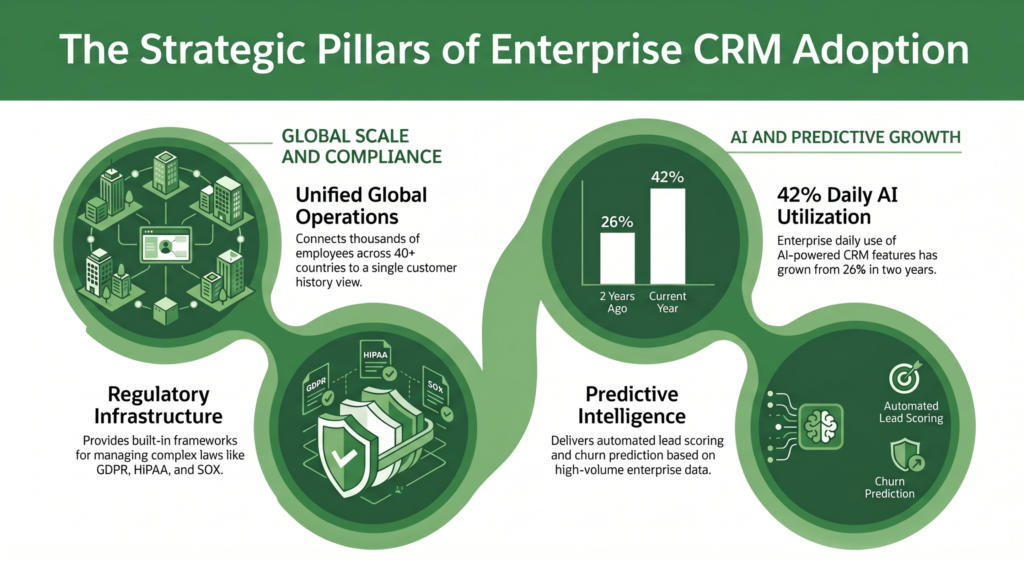
Data unification across global operations. A Fortune 500 company might have 50,000 customer-facing employees spread across 40 countries. Without CRM, every region operates from fragmented customer data. With CRM, a salesperson in Singapore can see the same customer history as the service rep in Mexico City. That unified view is worth billions in retention and expansion revenue for enterprises at this scale.
Regulatory compliance at enterprise complexity. GDPR, CCPA, HIPAA, SOX, and a growing list of regional data protection laws make enterprise customer data management a legal minefield. Modern CRM platforms like Salesforce include compliance frameworks that would take in-house teams years and millions of dollars to build. For regulated industries like banking, insurance, and healthcare, CRM compliance tooling is a non-negotiable infrastructure layer.
AI and predictive analytics integration. Fortune 500 companies were early adopters of AI-powered CRM because the data volume justifies the investment. Salesforce Einstein, Microsoft Dynamics Copilot, and Oracle AI Apps all deliver predictive lead scoring, next-best-action recommendations, and churn prediction that small businesses can’t economically deploy but that move the needle meaningfully for enterprises. 42% of Fortune 500 companies now use AI-powered CRM features daily, up from 26% just two years ago.
While Salesforce dominates, the Fortune 500 CRM landscape isn’t monoculture. The full vendor picture looks like this:
| CRM Platform | Fortune 500 Share | Total Companies Using |
|---|---|---|
| Salesforce | 80-90% | 150,000+ globally |
| Microsoft Dynamics 365 | 15-20% (often alongside Salesforce) | 40,000+ |
| Oracle CX / Siebel | 8-12% | 15,000+ legacy accounts |
| SAP C/4HANA + SAP CRM | 6-10% | 30,000+ |
| HubSpot Enterprise | 3-5% (mostly mid-market, growing into F500) | 210,000+ total |
| Zoho CRM | 1-2% at F500 level | 250,000+ total |
| Adobe Experience Cloud | Bundled with marketing tech at 20+ F500 accounts | N/A |
The key insight for B2B targeting: Fortune 500 companies rarely use just one CRM. Large enterprises typically run Salesforce as the primary system but layer Microsoft Dynamics for specific business units or Oracle for legacy workflows.
If you’re selling into these accounts, identifying the full technology stack, not just the dominant CRM, is what separates high-performing outbound from generic campaigns.
Every vendor selling into the Fortune 500 faces the same problem. You know who you want to reach. You just can’t find the right people fast enough, and generic firmographic lists don’t segment by who’s actually running the CRM you integrate with or compete against.
CRM users email lists solve this problem directly. Instead of starting outbound with “I hope this company uses the right tech stack,” you start with verified data on which platform they run, at what seat count, and who the administrator or operational owner is. That shifts the entire sales motion from cold prospecting to warm, contextual outreach built around a specific technology hook.
For vendors in these categories, a well-segmented CRM users list is one of the highest-leverage data investments you can make:
Span Global Services maintains a verified CRM users database covering 1.2 million+ companies globally, including deep penetration into the Fortune 500 and Global 2000 enterprise segments. What separates our CRM users list from standard firmographic databases:
Combined with our Salesforce CRM users list for vendors who specifically need Salesforce-only segmentation, this data infrastructure gives B2B sellers the precision required to build predictable pipeline from enterprise accounts.
Approximately 90% of Fortune 500 companies use CRM software, with the vast majority running Salesforce. The remaining 10% typically run Microsoft Dynamics, Oracle, or SAP CRM systems. When you include all CRM platforms, effectively 100% of Fortune 500 companies are CRM-enabled in some capacity.
Salesforce dominates because of four enterprise-specific advantages: scalability that supports global operations across 50,000+ users, compliance frameworks for GDPR, HIPAA, SOX, and regional data protection laws, deep ecosystem integrations with SAP, Oracle, and other enterprise systems, and AI features through Einstein that require massive data volumes to deliver ROI. These are the exact capabilities Fortune 500 scale demands.
Yes. At Span Global Services, you can filter our CRM users list by company size, revenue, and Fortune 500 or Global 2000 status to build a segment of only the largest enterprise accounts. You can further filter by specific CRM platform, job title, department, and geography to match your exact ideal customer profile.
Quality CRM users lists verify adoption through multiple signals: technographic web fingerprinting that detects CRM-specific scripts and portals, case studies and press releases where the CRM vendor publicly names the customer, job postings that mention specific CRM tools, third-party data validation from technology partners, and direct confirmation through verified customer references. Relying on any single signal produces outdated or inaccurate data.
Campaigns targeting Fortune 500 CRM users typically achieve 25-45% higher engagement rates than generic enterprise outreach because the messaging can lead with specific integration value, competitive displacement arguments, or platform-native workflows. Precision matters more than volume at this level of the market, and verified technographic targeting is what unlocks that precision.
Fortune 500 CRM adoption is one of the most mature, consolidated, and predictable technology markets in the enterprise world. 90% of the Fortune 500 runs Salesforce, and essentially all 500 run some form of CRM. For B2B vendors selling into this segment, the question isn’t whether to target CRM-enabled accounts. It’s how precisely you can segment them by platform, cloud, edition, and decision-maker role.
The companies winning Fortune 500 enterprise pipeline right now aren’t the ones with the biggest outbound teams. They’re the ones with the cleanest technographic data and the tightest ICP definitions. A verified CRM users list turns that precision into a repeatable targeting engine.
Ready to see what verified CRM data looks like for your specific ICP? Request a sample of our CRM users list to get started.